Showing posts with label Honey--Get Me Rewrite. Show all posts

Thursday, April 24, 2025

Possibly the Funniest Misspelling

I won't quote the exact way it was used, but on a social media post today I saw a person spell the word dementia as dimensia.

It almost qualifies as an eggcorn, as if a person with dementia is in another dimension. That's a pleasant way to think of it, compared to the connotation of demented.

I never thought about the etymology of demented or dementia before now, but of course de- is from Latin, "away from" and -ment comes from mens, "mind."

Sunday, April 13, 2025

Watch Those Headlines

Many people have written about misleading headlines that omit context and detail — usually in the realm of political coverage. Here's a good example from medical research:

That's a big headline, which seems pretty clear. But, it turns out, it shouldn't be so clear. If a reader is only scanning the page, the takeaway that vitamin D supplements are probably not worth taking is untrue. 

The secondary heading, whose point size only about 50% larger than the text type, clarifies that the study was only looking at the effect of vitamin D on acute respiratory infections and that vitamin D "does have other benefits"... but the much larger headline makes no reference to that.

In the story itself, these important details are given on those other benefits:

It helps prevent musculoskeletal diseases such as rickets and osteomalacia...and is essential for absorbing calcium, reducing the risk of osteoporosis and bone fractures.

"So if people are already taking a vitamin D supplement for musculoskeletal health, either prescribed or over-the-counter, they should not stop taking it," [one of the study authors] said. "Our findings relate only to the question of protection against" acute respiratory infections.

So the study authors are explicit that their work should not be used to discontinue use of vitamin D for the reasons that most people who use it, but the headline blares a general message of its uselessness. 

Great job, Star Tribune. I guess this is an example of clickbait translating to print, with no regard for how it reflects the content of the story.

And just as an aside, what's with the capital V on Vitamin in the headline, when it's not capitalized in the story?

__

I don't know how the Washington Post headlined the story in its print edition, but the online headline reads "Vitamin D supplements may not help against acute respiratory infections."

Tuesday, September 24, 2024

Funny Map

I saw this map on Twitter today: 

Its reason for being posted ("Still so much work to do when it comes to decarbonizing the US power grid.") is interesting, of course, but I was too distracted by the switching of Minnesota and Michigan. 

I think the people who made this grid map — which has other problems, like the location of Kansas between New Mexico and Arkansas, or afterthought-D.C. anchoring Florida — clearly have confused Minnesota and Michigan. 

Yes, it's bad enough to have Illinois lined up between Minnesota and Michigan, with Wisconsin above them all, but at least get the two M states in the correct order from east to west. Geez.

__

It looks like I wrote about another square map before.


Tuesday, January 9, 2024

Anti-Branding

I've never liked the word "branding," but I feel as though I have to use it write this post.

Today I learned the organization Be The Match was originally known as the National Marrow Donor Program. They changed the name fairly early in their existence and have spent the years since building up what's called "brand equity" in the new name.

Be The Match is a much catchier name than National Marrow Donor Program, though I suppose you could make an argument that the longer name is clearer and possible better for search engine optimization.

But either one is better than the new name the organization has chosen, according to the story I saw in today's Star Tribune (gift link): 

NMDP. 

If that sounds like a secretive intelligence agency from the Soviet Union, I agree with you.

I guess the organization's focus groups were telling them that 30% of people thought "Be The Match" sounded like a dating service. Also, advances in transplant science have made the need to match exactly less important. And the organization does more than just register people for transplants and find donors.

But in my opinion, none of those are a good reason to change to NMDP specifically. If 30% think it's a dating service, 70% don't think that. 

What do 70% think NMDP is? Numb Dump? They don't think it's anything at all, or they may think it sounds like the aforementioned Soviet intelligence service. Be The Match has spent all these years building awareness and now it's throwing it away.

NMDP also has no SEO, compared to just spelling the name out. Or they could just come up with a new, pronounceable name and then build it up as a brand all over again. That would also make more sense.

Because at least it wouldn't be Numb Dump, the secret police of the bone marrow world.


Sunday, December 3, 2023

The Greatest Corrections

There was a pair of additional posts from Bluesky in November 2023 that appeared next to each other, and that took too much description to include yesterday.

This really is the greatest correction of all time:


Ashton Pittman


This really is the greatest correction of all time:


Eric Roston

Every time I think of either of these, I laugh out loud. Literally. I don't roll on the floor laughing, but I do laugh out loud. Especially if I imagine myself reading them in the original publication.

The first correction is from the New Yorker. I'm not sure when it ran exactly, but it was probably some time before 2000, either during Pat Buchanan's time in the Reagan White House or while he was running to the right of more mainstream Republicans in the 1990s. 

Given Buchanan's politics, the mishearing (misunderstanding) of "us-and-them" as "S&M" is not that far off, if one takes S&M to mean sadistic. I suppose a New Yorker-level fact-checker should have been suspicious and gone back to listen to the interview tape, but it was in a quote: it wasn't a statement of fact being made by the writer. Maybe the tape was bad and it was hard to make out what was said. Who knows?

The second correction is much more recent, around the time Lt. Col. Alexander Vindman testified before Congress in October 2019. This is an obvious and unforgivable error that any proofreader should have caught. And it was a statement of fact made by the magazine.

And yet, even as I typed the words "unforgivable error" and reread the original mistake, I thought of someone being awarded a Purple Heart for an injury from an IUD…and laughed again.


Wednesday, November 8, 2023

It's Not Enshrined

Am I the only one who's sick of hearing that states are "enshrining" abortion rights in their constitutions?

Why do members of the media insist on using this religious word to describe a political action?

Aside from the obvious meaning, the definition of enshrine is "to cherish as sacred." 

All these states are doing is adding the right to abortion to their constitution. Maybe you could say they're categorizing it as a civil right. But they are not cherishing it as sacred or building a shrine around it.

But it seems to me that the use of this word is being used — whether purposely or unconsciously — to categorize abortion as a religious choice, as if it were the polar opposite of the religious belief of evangelicals. Opposite, but still religious — the way the Christian Right tries to insist that atheism or science are religions, because they can't imagine life without religion.

Somehow it isn't possible that abortion is simply a person having control of their own body and their health, the same way they do when it comes to deciding whether they will donate a kidney or part of their liver, even though it will save someone else's life.


Sunday, March 12, 2023

Mistakes Were Made

I have tried hard to give up my long-time role as a grammar (and usage) curmudgeon. I know that my writing is far from perfect, as readers of this blog would surely point out.

However. 

When I read work that has been professionally copy-edited and still contains not just typos but what I've always called "thinkos" — examples that show the copy editor does not know what the usage should be — I can't help but groan.

I saw three such examples in the last day.

First was in a Star Tribune headline:

Discomfort is a noun. Discomfit is the verb this headline-writer was looking for, and the copy editor (assuming there still is one at the Strib) should have known that.*

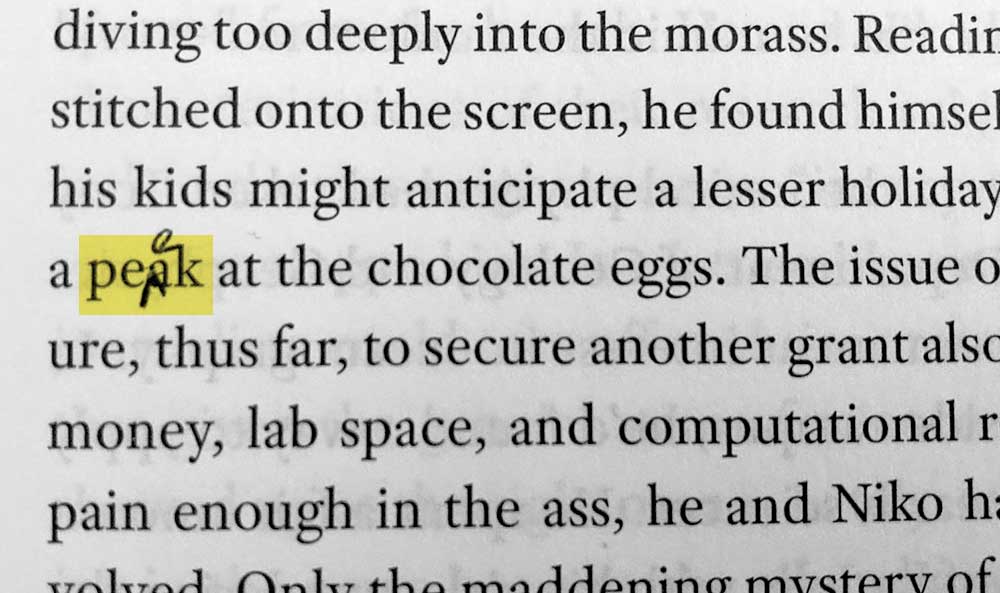
The other two examples were the same error, occurring twice in the book I'm reading. It's a hard-cover novel published by Simon & Schuster:

That first instance appears on page 1 of the book! (Yes, I do correct errors in books I own.)

This peek/peak mistake is pretty unforgivable as a copy-editing error: I'm surprised that a spell-checker or grammar-checker didn't catch it. (Worst-case scenario: was it caught and the copy editor overruled the correction? Hah.)

___

*Oh, gee, here I was writing this and I thought to look up whether discomfort is sometimes used as a verb and I found that it is, according to Merriam Webster online. That led me to Garner's Modern American Usage, Third Edition, which lists it as Stage 4: a form that has become virtually universal but is opposed on cogent grounds by a few linguistic stalwarts. Sigh.

Thinking a bit more about the discomfort/discomfit choice, if it was a choice on the part of the Strib staff, I wonder if they're afraid their readers would be unfamiliar with the word discomfit and think that usage was a mistake. Sigh again.


Friday, October 28, 2022

Fractious Fraction

I remember holding out against calling September 11, 2001 "9/11." Something about it just bugged me, and it seemed as though September 11 (or Sept. 11 when space constrained) made a good enough shorthand.

Even more, I refuse to refer to January 6, 2021 as "1/6," which I'm pretty sure has not become common yet. Here's a good example of why it's a bad idea from today's Star Tribune:

One-sixth of a rioter? Combined with the 7½ years, the headline almost sounds like it's meant to be a word problem for children learning to multiply fractions…except it's not.

(And wow, check out the typo in the secondary headline!)


Tuesday, October 18, 2022

Arguing with a Map

I don't doubt the underlying data about maternity care deserts in this NPR story, based on a March of Dimes report, but I have some arguments with the way the map looks:

(Note: both maps are viewable in much better versions on the March of Dimes report site.)

My arguments are based on my knowledge of the parts of the country I know best, Minnesota and central Upstate New York. I'm going to extrapolate my wondering a bit to a few other parts of the country.

Before proceeding, it's important to know what that map is based on, which is this map of the number of hospitals (with maternity wards) or birth centers in a county:

Not surprisingly, the light blue counties on this map are also light blue on the first map, and the dark blue counties are sometimes the red counties. 

My first argument is with the dark blue counties that aren't red or at least orange. For instance, all but two of those light-colored counties in Upstate New York on the first map are dark blue on the second map. Some of them are colored yellow — meaning they have moderate access — but many are are light blue, as if their access is just fine as is. Neither moderate or full access makes no sense to me, as a person who grew up there and knows how much rural and small-city poverty there is, how many people have no or unreliable transportation, and what the geography is like (the roads aren't straight, people!). 

Second, I don't understand why there are single counties on the first map anywhere in the rest of the country that have five or more hospitals or birth centers, surrounded by counties that are care deserts. Shouldn't the immediately surrounding counties be marked orange or at least yellow? If you're in a county adjacent to a county with at least five places to give birth, unless that county is gigantic, it seems like you have some access to it (see my next argument). 

Logically, shouldn't there be gradations of color, unless there's a geographic barrier in between? Look at Texas, for instance, or South Dakota. Do some of the hospitals prohibit people from adjacent counties from using their services? Why do counties without services in these states get labeled as care deserts, but not the ones in New York?

Third, not all counties are created equal in size, and their their hospitals and birthing centers are not centrally located. There are several counties on this map that are gigantic and are colored light blue, but I would be willing to bet money all of the maternity coverage is clustered at one end of the county, leaving a gap bigger than many noted for other entire counties. One obvious example is St. Louis County, Minnesota — that big slab of light blue running from the Canadian border to the western point of Lake Superior. The city of Duluth is at the very south end of the county, and with it almost all of the county's population, hospitals, and birthing centers. It looks like there is a birthing center in the small city of Virginia, but that's it for the rest of the county — nothing in the entire north half, which is larger than most counties in the country. I wonder the same thing about some of the gigantic counties in Arizona and southeastern California.

My third argument is a limitation of using counties for data representation, so I don't fault the study's creators for that, really — though I wish it could be acknowledged somewhere. The other two points are more substantive about how they have interpreted the data for translation into this visual.


Thursday, September 8, 2022

Not Yellow

I'm just back from another road trip. While traveling across the country, I had the chance to ruminate once again about the trucking company called Yellow. You know, the one with the orange logo:

Just after driving past that truck, I saw an actual yellow truck:

Which wasn't part of the Yellow Corporation.

Well, I knew there had to be more to those orange Yellow logos, and of course there is. 

The Yellow Corporation's Wikipedia page gives lots of information on all the mergers and acquisitions along the company's way, but the basic idea is that originally the founder used actual yellow, and even coined the use of the term yellow cab. (He didn't get the national trademark, though. Oops.)

But fairly early in the company's existence (1929), the company's managers decided (with the help of consultants from DuPont!) that orange had the best visibility. And not just any orange, but specifically "Swamp Holly Orange, "whatever that name means.

I don't know... school bus yellow seems pretty visible to me, and fits a lot better with a company named Yellow. 


Wednesday, August 31, 2022

Nitpicking About Capitalization

Sometimes you hear a person say "small 'd' democratic" to differentiate from Democratic, as in the Democratic Party. In these days of Republican rejection of the idea of democracy in general, it seems somewhat important to make sure people know which kind of democratic/Democratic one is talking about.

In today's Star Tribune (and possibly in the New York Times, from which the original column came) there is an editing error that I must nitpick because it feeds into this confusion:

Why is that "D" capitalized, given the Star Tribune's general use of lower case in its headlines? The rule, according to AP and most other style guides, is that capital letters on the first word following a colon should be reserved for complete sentences. This is not a complete sentence.

In this example, the capital D adds confusion to the meaning of the headline. Does the writer mean democratizer (small "d" democracy) or Democratizer (maker of Democrats)? Republicans would like to know, and jump to different conclusions based on the answer. The writer, given what I know of her, would not intend the latter meaning.

Meanwhile, I suspect the culture implied in the headline, article, and book the two refer to would more accurately be spelled Culture with a capital "C" (what is sometimes called "high culture" or "high-brow culture"), because it's not possible to crush culture in the anthropological sense. Culture in that sense just changes and becomes something else: It's always something humans create. 

Only people with an idea that culture is a specific set of artistic artifacts think it can be crushed. 


Wednesday, August 3, 2022

Dragging the Wrong Ahab

The Star Tribune continues its bumbling run without a regular political cartoonist. Today's cartoon was this from Rivers, an anonymous conservative who publishes through the Cagle consortium. 

(Click to enlarge.)

At least Rivers can draw, but their concepts are too often very far inside the right-wing bubble and thus mostly incomprehensible. This cartoon is understandable but Rivers has the concept backwards: Who could think that Trump is the whale dragging Democrats around? What? 

Which party is it that has given up almost everything it supposedly stood for? Whose leaders are breaking their oaths of office? Whose election strategy, following Trump, is now to preemptively declare every election illegitimate?

This is a corrected version of the cartoon, and it's a great metaphor for Republicans:

Too bad Rivers is too convinced by the right-wing worldview to have even realized that the cartoon would work better this way.


Wednesday, July 13, 2022

A Command, Even Without a Comma

I was up in the far northwestern exurbs of the Minneapolis recently and saw this building with these signs. (I didn't get a chance to take a photo, but here's a rendering of it from the architectural firm that built it):

A suburban-style commercial building with two lit signs on either side of the front corner that read DIE TECHNOLOGY

Now, I know the name refers to dies as in tool and die, and that the way I'm reading it requires a comma. 

But am I not correct in thinking that at least 90% of native English speakers would get the meaning "die, technology" from that name?


Wednesday, May 4, 2022

Squaring the Map

Have I posted before about these attempts at creating a square-format map of the U.S.? I think I have, but I'm not sure.

I saw this version recently. The data it relays is not the point of this post:

As a person from Minnesota who has relatives in Wisconsin, the thing that immediately irritated me about it was the way Wisconsin is bumped up above the U.S./Canada border, and therefore above Minnesota and Michigan. What?

Of course, it's not possible to place the states on a grid because they're much too irregular, so compromises have to be made. But are better compromises possible?

Here's my suggestion, at least for the Northeast/Midwest:

The Northeast is pretty much impossible. (Yes, I know Vermont is not above New York.) And that still doesn't deal with the fact that the Carolinas are bizarrely arranged, Washington, D.C. is off the cost of South Carolina, and Texas, Oklahoma, and Kansas are wrong. Although I have to admit, I kind of like the idea of Texas as equal in size to the other states and only being accessible from Oklahoma.


Sunday, February 13, 2022

None of the Above

It's an odd feeling when your existence is not acknowledged as part of reality.

I know there are much worse examples than this, but I encountered one yesterday while filling out a survey. Its purpose was to correlate attitudes about a particular subject (perception of what's a "normal" cold or hot temperature) with what part of the country respondents are from originally and currently. 

The way the survey asked about location of origin was like this:

The fact that it assumes respondents grew up in a city seems strange to me. Why didn't the writer ask, What's was the nearest major metro area when you were growing up? if that's what they wanted to know?

In some ways, the longer explanation made it worse: the only other option was a suburb (that is near a "major metro"). 

And what about truly rural areas? What is a respondent supposed to assume counts as a major metro? Does everyone in Wyoming put in Cheyenne no matter where they live?

I'm not from a suburb, and the closest actual "city" is neither nearby nor a major metro. But I put that in as answer, grumbling the whole time.


Thursday, January 20, 2022

No More Belie, Just Stop

There it was in one of my morning newspapers, a headline using a verb that has lost its meaning:

Have most people ever known the definition of "belies"? I wonder. At this point, though, I think almost no one knows what it means, and those who think they do have it backwards.

As both the Grammarist site and Garner's Modern American Usage say, its meaning is to contradict or to give a false idea to, but it is subject to an extremely common misuse that is just the opposite: to reveal. Both attribute that to possible confusion with the similar word "betray."

In the case of this Pioneer Press headline, it makes some sense if the writer meant it either way, but it can only be a summary of the story with one meaning. It's almost a Mad Lib, since many readers will not know what the word means. "Omicron [verbs] its fatality danger." They would have been better off picking a different word that's clearer.

Omicron reveals its fatality danger
Variant's lower risks are offset by surge in U.S. COVID infections

Omicron hides its fatality danger
Variant's lower risks are offset by surge in U.S. COVID infections

"Obscures" would be a better word than "hides." If the "its" was dropped from the headline, it would fit in the space.

Any of these would have made for a better headline, depending on which one best reflected the content of the story.


Tuesday, December 28, 2021

A Small Gripe, Reiterated

I mentioned a misusage back in 2013 in one of my Flips of the Tongue posts, and I've heard or read it a number of times since then. My impression is that it's becoming more common, though I hope not. 

Here's a recent example from a letter to the editor in the Star Tribune

"The persistent pit in my stomach tells me that we have made a terrible mistake."

As Washington State University Professor Paul Brians puts it in this list of errors, compiled in his book  Common Errors in English Usage:

Just as you can love someone from the bottom of your heart, you can also experience a sensation of dread in the pit (bottom) of your stomach. I don’t know whether people who mangle this common expression into “pit in my stomach” envision an ulcer, an irritating peach pit they’ve swallowed or are thinking of the pyloric sphincter; but they’ve got it wrong.

This confusion of "pit of ___ stomach" with "pit in ___ stomach" didn't make it into Brian Garner's Modern American Usage (third edition, 2009), however. Maybe someone with a copy of his fourth edition can tell me if it's in there.

Chris Hayes, I have noted a few times over the years, is one of the misusers of this phrase. Much as I dislike it, that doesn't bother me as much as Rachel Maddow's use (misuse) of "fulsome," which she thinks is interchangeable with "lavish," when describing praise. I guess because it sounds like "full." 

Garner labels uses like Maddow's as Stage 4, meaning it is "virtually universal but is opposed on cogent grounds by a few linguistic stalwarts..." His shorthand for Stage 4 is "Ubiquitous but..."

"Fulsome" is such a great word. I am sorry to see it subside into vague positivity.

__

Update: Checking the etymology of "fulsome" is an eye-opener. It's derived from the Middle English words for "full" and "some," just as it sounds, and as etymonline puts it, was "Perhaps a case of ironic understatement." The listing goes on:

Sense extended to "plump, well-fed" (mid-14c.), then "arousing disgust" (similar to the feeling of having over-eaten), late 14c. Via the sense of "causing nausea" it came to be used of language, "offensive to taste or good manners" (early 15c.); especially "excessively flattering" (1660s). Since the 1960s, however, it commonly has been used in its original, favorable sense, especially in fulsome praise.

This use since the 1960s reinforces Garner's Stage 4 assessment. I don't remember hearing it until recently, personally, which is probably why I find it so hard on my ear.


Saturday, August 21, 2021

A Bad Comparison

I think it's probably obvious that I take covid about as seriously as any non-medical person does, or at least anyone who hasn't had close family or friends die from the disease. 

And 630,000 dead is horrendous and unforgivable.

But I still have to question the judgment of people who tweet things like this. (I'm not even going to cite who it's from because I think it's so off the mark.)

US casualties of the American Civil War
750,000

US reported COVID Deaths as of August 2021
630,000

Yes, sure, the absolute numbers of people who've died from covid are approaching the number dead from the Civil War.

But the relative size of the U.S. population was less than a 10th as much in 1860 (about 31.5 million), and the Civil War dead were almost all from one sex and in the relatively early years of life. 

The impact of that much loss of life (even if it hadn't been from a war) was staggering. We would have to lose more than 7.5 million people to equal its scale today, and even then if it was equally distributed among genders it would be less bad than the Civil War's resulting gender imbalance. 

Covid is a lot, it's terrible, and it may get even worse. But we don't have to make it seem worse than it is, relative to the past. 


Wednesday, July 14, 2021

Off the Rails

Long day, and the world is overwhelming. I guess there's some good news on the infrastructure bill (maybe, we'll see if they manage to pass it) in the Senate, but they still haven't gotten rid of the filibuster so we can have a democracy.

But the thing I want to call attention to is this:

The nation’s top military leaders discussed a plan to resign one by one rather than carry out dangerous orders in the event of an attempted coup by then-President Donald Trump and his allies after the November election, a new book reveals.
CNN Politics

I'm sorry, the military was contingency planning for a coup and we're finding it out as a book teaser so that our coziest political journalists can make a little more cash on the side?
Will Stancil

For some reason, that pair of ugly absurdities makes me want to share this bit from Doug Muder at The Weekly Sift, who this week resurrected a Wired cover (and cover story) from 25 years ago. "When you predict the future," he wrote, "sometimes you get things just a little bit wrong. Like Wired, 24 years ago:"

We are watching the beginnings of a global economic boom on a scale never experienced before. We have entered a period of sustained growth that could eventually double the world’s economy every dozen years and bring increasing prosperity for—quite literally—billions of people on the planet. We are riding the early waves of a 25-year run of a greatly expanding economy that will do much to solve seemingly intractable problems like poverty and to ease tensions throughout the world. And we’ll do it without blowing the lid off the environment.

Yeah, no, Wired. Short of nuclear war, it turns out that was all about as wrong as it could be, plus more.


Thursday, March 11, 2021

CNN Fail

It pretty much goes without saying that our mainstream media will fail 90+% of the time when it comes to recognizing that politics is not a horse race, government is not a sport, and there are not "both sides" on the question of fascism, the need for democracy, or the climate crisis. Also, that bipartisanship is something (like deficits) that only applies to Democrats.

Here's the latest example:

A tweet with link from CNN Politics has this headline: Negotiator-in-chief Biden notches his first win but with a bipartisan governing loss.

The responses on Twitter were withering about both the sports terminology ("notches his first win") and even more so that it describes the outcome as a loss for bipartisanship:

1) politics aren't sports
2) if zero republicans refused to vote for a bill that had broad support and helps people, that falls on them
Sarah Lerner

if politics were sports "the democrats win with no help from the other team" would be very easy to understand... wait... is politics sports???
Ruby GL

This was not a setback to bipartisanship. The bipartisanship is with the American people. The GOP Congress chose not to represent the views of the Republican rank and file. If the GOP Congress wants bipartisanship, it can quit playing silly obstructionist games.
John Rutledge

Not fucking once do I remember the national media framing Trump's actions this way.
Ken Tremendous

Does CNN Politics talk to CNN Polling? 85% of Americans support tax policies in the bill. 61% support the bill overall. 66% say it will help the economy. Seems pretty bipartisan to me!
@NicoleKowalski5

Democrats voted for relief when Trump was President, even though it could help Trump's political position. Why? Because they wanted to give help to Americans. NO Republicans voted for relief when Biden is President. Why? Because hurting Biden is more important than helping people. Who's bipartisan?
@Krazy_Kris

"Here is a thing — like the deficit — that we will only worry about when Democrats are in power" should be the headline...
@_AdeleBuck

My thought is that the outcome of the vote clearly is a setback for Congressional bipartisanship, but only for the Republican Party. They've shown that not a single one of them cares about the need for it, despite the greatest crisis in generations.

The fact that their voters didn't already know that about them before the 2020 election, or didn't care about it enough to vote them out, is what distresses me.