Showing posts sorted by date for query arthur middleton. Sort by relevance Show all posts

Sunday, March 20, 2016

Sophistipups: A Dog of a Bracelet

It's been a long time since I posted in the Beyond Kitsch category, but an ad in today's Parade magazine made me do it.


Meet the "Sophistipups" bracelet from the Bradford Exchange:

Here's a unique combination of sophisticated style and sparkling whimsy that is as irresistible as the pups who inspired it. Trend-setting, fashionable and unique, this is a bracelet not to be missed!

Our "Sophistipups" Bracelet is a hinged bangle-style bracelet in gleaming enamel. At each end of the bracelet is a golden head and face of your favorite pup adorned with genuine Swarovski crystals. Each pup also wears a sparkling collar of crystals in a coordinating color. The inside of the bangle is engraved with "My (name of breed) Leaves Pawprints on My Heart" and tiny paw prints. Dangling from one of the "collars" is a hanging heart charm engraved with an expression of love for your loyal friend....

This exclusively-designed bracelet is a remarkable value at $119*. And you can pay for it in 4 convenient monthly installments of $29.75. The bracelet arrives in a velvet jewelry pouch and gift box along with a Certificate of Authenticity. To reserve a bracelet in the breed of your choice, send no money now; just mail in your Reservation Application....
That is some well-crafted low-brow copywriting. I especially appreciate the use of unneeded capital letters on Bracelet, Certificate of Authenticity, and Reservation Application.


Here's a close-up so you can see those irresistible golden [enamel] heads, not to mention the tiny paw prints inside.

Topping off the general kitsch of the concept, note the type used in the layout: there are three fonts in the headline alone, plus others scattered throughout and on the jewelry itself.

It's hard to see in this photo, but in the lower right corner, the caption below the "I Love My Yorkie" heart starts with the letter H in Galadriel, the font used for the word "GLAMOUR" in the headline. Unfortunately, because Galadriel has a very high crossbar, the H looks more like an N or an M. Or maybe it most looks like the Greek letter pi. So the "hanging heart charm" becomes the "panging heart charm," whatever that is.


Here's one last close-up to appreciate how the crystals are incorporated into the various dogs' faces. Topping off the general kitsch level of the product and the ad, notice that the female dogs have been identified with pink crystals inside their ears.

The only positive thing I have to say about this product: It's better than anything sold by Arthur Middleton Capital Holdings in Canton, Ohio. At least a person who buys this dog of a bracelet is getting something that has been designed to their tastes, can see what they're getting in the ad, and knows how much they're paying for it.


Wednesday, November 26, 2014

Clear-Cast "Free TV" Ad Gives Slick a Bad Name

Free TV is once again on offer in the ad pages of my local newspaper. Last time the ad for Clear-Cast (or ClearCast) called its product "free TV" with "953 shows," which everyone who saw the ad interpreted to mean "953 channels."

Now it's trying to spin the recent Supreme Court decision against tech start-up Aereo as if it has something to do with this antenna that has existed for years.

Look at this headline, especially juxtaposed to the large photo of a wall of television screens:


Clearly the headline and photo are meant to get your attention by saying you can get a free television -- not free television broadcasts. (What, the Supreme Court ruled we all get free TVs? This looks like a news story! I must read it.)

If you read the ad, of course, you become a bit bewildered about where the free TV is and finally realize they're talking about free television shows through an antenna. Though in the caption below the large photo, they even dare to claim "It's like getting a new HDTV for free."

I love how the ad repeatedly uses the phrase "slick little device" or "slick little micro antenna" to describe the product. Fourteen times, in fact -- sometimes up to three times in a paragraph. (They also used the word "sleek" once. I wonder if that was a typo?) It's slick, all right, but mostly in the tradition of "slick talking." 

There's even a paragraph where they appear to mislead readers about what channels they'll get with the slick little antenna. "The device is engineered to access solely over-the-air signals that include all the top-rated national and all broadcast stations, like DISNEY (ABC), COMCAST (NBC), CBS, 21st Century Fox (FOX), PBS, CW, and about 90% of the most watched TV shows...." Notice how they play up DISNEY, COMCAST, and FOX (as in Fox News) -- all names associated with cable channels that will not be available using the Clear-Cast antenna.

I particularly love how they're so proud their product is engineered to receive over-the-air signals... you know. Like an antenna.

I also noticed that the price this time is $88 per unit. In the 2012 ad, they were only $47 (and were advertised in a New York paper for only $38). So that's an 87 or a 132 percent price increase, depending on which market you're in.

Of course, there are volume discounts if you get more than one, and if you have more than one TV, you'll need one for each. As the form at the bottom of the ad says, "You only need one Clear-Cast brand micro antenna device for each TV that you want Free channels on." Well, thank goodness you don't need two of them for each TV! Wow, you guys are tech geniuses.

Any way you look at it, it's a ripoff because you can buy an effective digital antenna for as little as $8, according to Consumer Reports.

________

Here's a list of my past posts on the scammers from Canton, Ohio, who want to sell you the slick little device. They also bring you Amish heaters, uncut $2 bills, fake health care, safes to put your over-priced coin collection in, swamp coolers pretending to be air conditioners, cheap but over-priced laptop computers, and weight-loss miracle "drugs."

They work through a parent company called Arthur Middleton Capitol Holdings.

Monday, July 14, 2014

Bags of Cash Are a Bad Deal, Tennessee

The scammers at Arthur Middleton Capitol Holdings and the World Reserve Monetary Exchange are at it again. This may be the closest thing to a bald-faced lie I've seen from them to date:


Yes, the headline says "Bags of Cash Go to Residents in 92 TN Counties." The italic text below that says the bags are "loaded" with "real U.S. Gov't issued money" and all you have to do is cover a $99 Vault Bag fee. Within a time limit of three days, of course. Act now!

Ninety-nine dollars for a Vault Bag fee (plus shipping and handling). How much money is in these bags? They seem to be bulging with bills, based on the photo at the top of the ad that shows an armed and serious Toronto Mayor Doug Ford.

Well, if you read the fine print, you get eight $2 bills and three $1 bills. That's $19 of face value for your $99 payment.

Some of the bills are uncut, which the WRME likes to pretend makes them more valuable, and a few others have a red seal or a blue seal. Seems unlikely to be worth anything like the $80 difference in cost, and the ad copy obscures this with the usual hand-waving about how "there's no telling how much just one of these rarely seen bills could be worth some day..."

The small disclaimer at the bottom of the page makes it clear WRME is implies no such statement of fact, of course.

That's all bad enough, but the illustration of various denominations at lower right is the biggest misdirection of all. It shows a sheet of four $50 bills, plus sheets of $5, $10, and $20 bills and a single $100 bill.


None of these are included in the "vault packs" because they aren't marked with a white star. Above the images, the ad says "All 11 U.S. Gov't issued notes with white stars are in each Vault Bag." And then it says "But only residents who beat the deadline are getting every single U.S. note shown below by covering the additional claim fee within the next 3 days."

That last sentence is completely unclear to me. Are they saying that paying an additional fee (beyond $99, plus shipping and handling) will get you the uncut $50s and other larger bills shown, which would have a face value of over $400? If so, how much is that "additional claim fee"? The ad doesn't say.

Or do the words "every single U.S note shown below" still mean only the ones with the white stars, and the additional claim fee refers to the same $99 fee? In my opinion, they want it to be unclear, so that people think they will get all the bills shown.

My advice to anyone who reads this ad is to buy nothing and to complain to your local paper about the fact that they ran it in the first place.

Monday, March 24, 2014

Senior Mobile Phones: $97 Is Not Free

CompTek couldn't sell their overpriced laptops, so now they're "giving away" phones that cost $97.


This ad ran in both the Pioneer Press and Star Tribune. It's one of the most flagrantly misleading of all the ones from the scammers at Arthur Middleton Capital Holdings of Canton, Ohio, which I have written about over the years.

It says some version of the phrase "free phone" 21 times. It says the government urges you to carry a cell phone. It does everything except stand on its head to sound like it's an official announcement. It makes it sound like the company sponsoring the ad is so good-hearted that it's giving you a discount.

And then it slips in a $97 "activation fee" in a couple of spots. How does "the phones are being handed over to St. Paul area seniors for free" fit with that $97 charge? How is $97 free?

The part that irks me the most about the ad -- even more than the bait-and-switch from free to $97 plus shipping -- is the way it threatens the reader. "Yet millions of seniors are still risking their safety by not having [a phone]..." and "I'm so happy we got the phones. Now I know she'll be safe and I don't have to worry about her going out alone anymore..." and "Things can change in a blink of an eye. Imagine being all alone in an emergency..."

There are additional complications lurking in the phone's details, I suspect. You don't have to buy any minutes with it if you only plan to use it for emergencies, but it "comes with 250 anytime minutes good for sixty days. After that just call Senior Mobile to reload your phone with additional minutes as an added option..." No mention of what those added minutes cost, and it's not really totally clear if the first 250 minutes are included in the free/$97 initial cost.

Also, note that, in addition to the unknown shipping charge, returning the phone if you don't like it is a dicey proposition. According to the fine print, you have to return it at your own expense within 10 days in like-new condition. Your refund will be less shipping (what shipping? you paid for the shipping in both directions already) and a 15 percent "restocking" fee. And -- get this -- they are not responsible for lost returned shipments. So all they have to do is say they never got your returned phone.

I don't even know what trac phones and minutes cost on the market -- maybe $97 isn't that bad a deal with 250 minutes, if that's what CompTek is selling here. But the fact that they hide the price behind a free claim, along with their appeals to safety, make me suspect their motives and therefore their pricing.

Friday, December 2, 2011

BBB Denounces the Scammers from Canton, Ohio

Thanks to Twin Cities Daily Planet editor Mary Turck for her write-up on the Amish heaters, and for letting us all know that the Better Business Bureau of Minnesota and North Dakota has issued a press release decrying Arthur Middleton Capital Holdings for its deceptive advertising.

Finally!


Monday, October 24, 2011

Even More Heat Surge Absurdity

It almost seems as though the latest Amish heater ad from the Universal Media Syndicate is an attempt to see how many absurd claims can be packed into a single-page ad.

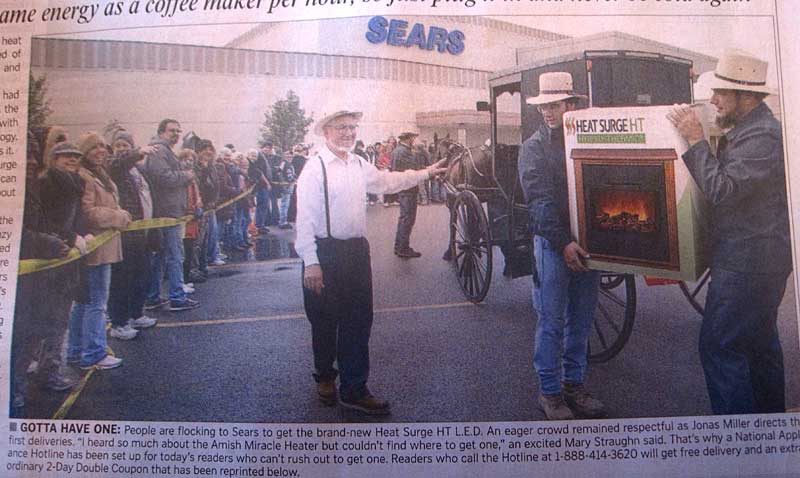
Right at the top is the dumbest staged photo I think I've ever seen: a line of people in a Sears parking lot, standing behind yellow caution tape, dressed in their winter coats as they wait for a crew of supposedly Amish men to unload a few Heat Surge boxes out of the back of a horse-drawn buggy.

Give me a break.


The idea that a huge retailer like Sears takes deliveries from guys in buggies is laughable. The implication that the men in the photo are actually Amish or the people behind the caution tape are customers is equally silly. The only true thing in this photo is the fact that Sears is now selling the heaters; they should be ashamed, in my opinion.

The ad's text is full of the same type of absurdity. The breathless copy crams in so many pseudo-technical terms it's like a Monty Python script. "This is the revolutionary Heat Surge HT L.E.D., the first-ever appliance with Hybrid-Thermic™ heat technology. Hybrid-Thermic heat is an engineering genius so advanced, it actually uses a micro-furnace from the Coast of China and a thermal heat exchanger to perform its miracles. The thermal heat exchanger acts like the rays of the sun to heat you, the kids, the pets and everything else. The micro-furnace then heats all the surrounding air.... In fact, it actually produces Ortho-Thermic™, bone-soothing heat."

Oh, wow, a micro-furnace from the Coast of China! We all know everything that comes from China is good. And a hot LED -- where do they get those? The reason LEDs are energy-efficient is because they don't put out heat. And how many more ™ marks can they use on made-up words like Ortho-Thermic?

A new section of the ad has the bold headline "A Consumer Best Buy," followed by the claim that it "boast[s] an overwhelming Consumer 'Best Buy' on the HeatReport.com website." This is clearly supposed to make readers think of Consumer Reports -- the venerable consumer watchdog, which has a history of giving the Heat Surge / Amish heaters a less than warm review. But HeatReport.com is a website created by Heat Surge -- it's not an independent review -- so it's full of glowing recommendations. Big surprise.

The ad refers again and again to a "double coupon" deal, but it never says how much the single coupon is for. The heater costs $398 if you call in the next 24 hours; it's $547 after that, although I had to read it about three times to find that price listed. The only difference from their past ads is that shipping and handling are included with this "coupon." To make up for that decrease, though, the $398 price is almost $100 more than they were selling heaters for last year. Maybe the price went up because of all that revolutionary technology from China.

The ad claims the heater uses $.09 of electricity per hour in "standard mode." It then says "yet it produces up to an amazing 4,606 British Thermal Units (BTU's) on the high setting." No mention of  how many BTUs it puts out on the standard setting, or how much electricity it uses on the high setting. (The Heat Surge website lists the standard setting as putting out 2,303 BTUs, so I would infer it costs $.18 per hour to run it on the high setting.) Note that 4,606 BTUs is less than the amount of heat put out by a 1,500-watt heater, and less than was put out by the version Heat Surge was selling last year. (4,606 BTUs equals about 1,350 watts.)

Just remember these facts:
  • The Amish heater costs $398. Electric heaters that put out comparable amounts of heat can be had for under $100. Even ones that come in furniture-like cabinets cost substantially less than $398.
  • $.09 per hour will be added to your electric bill whenever the heater is used in standard mode. If you run it 24 hours a day, that's $2.16, and if you do that for a month it adds about $65 to your bill. If you run it on high, the electric charges will double. Will your gas or oil bill be decreased by more than that? Natural gas creates cheaper heat per BTU than electricity -- 60 percent cheaper, according to Consumer Reports, so that seems doubtful to me.
______________

Here's some background on the Universal Media Syndicate and Arthur Middleton Capital Holdings, the company behind the Heat Surge ads.

Saturday, January 1, 2011

The Fascinating Year at DN3

Graph of Daughter Number Three blog traffic for 2010
Lately, I've been excavating my closets and basement (which means there'll be lots of future "It Came from the Basement" posts), but today I'm cleaning out my site statistics.

Boring stuff first:

  • Browser use was more diversified than at any time I can recall (36% Firefox, 32% Internet Explorer, 22% Safari, 9% Chrome).
  • 70 percent of the visitors came to my site only once (sad face).
  • Visitors came from almost every country in the world. Though nobody likes me in Guyana, Greenland, Bangladesh, Papua New Guinea, Laos, Azerbaijan, Turkmenistan, Kyrgyzstan, Syria or more than half of Africa (visitors did come from Egypt, Tunisia, Algeria, Morocco, Senegal, Ghana, Nigeria, Kenya, Uganda, Tanzania, Mozambique, and South Africa)
  • Not surprisingly, of the U.S. states, Minnesota led with 31% of the traffic. New York was second with a little under 8%. Daughter Number Three is least popular in Delaware (.09% of the traffic).
My two most-visited posts of the year were about Universal Media Syndicate topics: the "diet" pill Apatrim and the Mira-Cool swamp cooler.

Search Me

In keeping with those stats, the most common search terms were related to Apatrim or Mira-Cool, followed by others connected to UMS or Arthur Middleton Capital Holdings. They must have been running a lot of ads this year.

Search terms, as Carmella recently reported, make for fun reading. Some were done by inexperienced searchers:
  • "michele bachmann + photo" (never heard of Google Images?)
  • lynne thigpen actress (as if she might get confused with some other Lynne Thigpen who wasn't an actress?)
  • what percent of people think stuff about the westing game (umm... everyone who reads it?)
  • 75 separate searches that started with the word "the" (Google ignores all articles unless they're included in a phrase that's in quotes)
Others are looking for such bizarre topics, I wish I knew the whole story:
  • i am a symbol of times past. the daughter of a sevivor of white men in
  • george santayana solvent
  • what does a enema pan beetle eat?
  • how do i make a health card
  • i found a bat where did it go
  • cow's perspective of sam westing in the westing game
Some are working on an assignment without benefit of reading the book first:
  • quotes from the ghost map with page numbers
  • why did the puritans hate the american indians and the pilgrims didn,t?
  • what are some quotes turtle uses in the book westing game
  • what happens in chapter 3 of how we decide
  • write outlines on how to steal a car by pete hautman
  • what two things nurture the seeds of totalitarianism (gee, are there only two?)
  • why resist feed in novel feed?
Still others combine typos with thinkos:
  • how to no which there and their it is (but no question how to know which no/know to use)
  • ammonia smell coming for beef (watch out, beef, the ammonia smell is coming for you!)
  • bacon lattice turkey (maybe they were looking for my post on a turkey covered in a lattice of bacon, but maybe they were looking for bacon lettuce turkey... who can tell?)
  • can u give me a card number and a scurity cold to upgread my yearbook (wow, I hope that person was typing in the dark)
And here's the one I found most interesting of all:
  • who is daughternumberthree@blogspot.com
This person spent 48 minutes on the main page of the site.

Tuesday, December 7, 2010

Uncut $2 Bills Cost 6 Times Their Face Value

It's the holiday shopping season, which means it's time for a new offer from the World Reserve Monetary Exchange and the Universal Media Syndicate. This time it's uncut sheets of $2 bills, available for only 48 hours to people who live within a limited set of zip codes. No pressure!

Today's Star Tribune carried the ad. This offer is not a good deal because each sheet of currency (which comes in a plastic folder the ad calls a "bankers portfolio") sells for $48, when the face value of the currency is only $8. That price is six times the face value of the currency. Six times. Plus shipping!

Full page Universal Media Syndicate ad for World Reserve Monetary Exchange uncut $2 bill ad
The ad spouts all the usual misleading hyperbole about the value of these sheets:

  • People who buy them "will feel like they just won the lottery."
  • "..those who get in on this now will be the really smart ones. Just think what they could be worth someday!"
  • "VALUABLE... It's impossible to predict how much the bills will be worth in the future."
  • "Rare uncut sheets of real Gov't issued currency have sold at prestigious auction houses for thousands of dollars."
Ah yes, rare uncut sheets are worth a lot -- but these sheets are not rare at all. It's impossible to predict how much (or how little) the sheets will be worth in the future.

And, to balance their hyperbolic statements, the UMS copy writers are always careful to include a single instance of this caveat: "Currency values always fluctuate, and there are never any guarantees."

"But," the ad continues right after the caveat, "at just forty-eight dollars the full uncut sheet and bankers portfolio is a real steal..." I would agree it's a steal, but in my opinion the people who buy aren't the ones taking advantage of the steal -- it's the World Reserve and its parent company Arthur Middleton Capital Holding who are getting the "real steal" from their customers.

More stupidity in the ad's text:
  • "You would expect to only see uncut money sheets on display in the Oval Office or under guard at the Smithsonian." Who makes up this puffery?
  • "...they are so seldom seen, banks don't even have them." Well, duh. Banks have no need for uncut sheets of money, since they're in the business of circulating currency.
It appears there's a minimum order of three, which as a group the ad calls a "Vault Stack." I would argue that the full-width photo at top, showing large stacks of uncut bills, is meant to imply that this type of "stack" is what the buyer would be purchasing, rather than three sheets stuck into plastic folders.

Close up of the WRME ad's photo, full width on the page, showing armed guards moving stacks of money on carts
The ad makes a point of saying that the government stopped printing $2 bills in 2006, hoping to emphasize the scarcity/scare appeal of the offer. That's probably because there's not a lot of demand for $2 bills in circulating money. However, as of last fall, the Bureau of Engraving was selling these same uncut sheets on its ecommerce site for $2.815 per $2 bill, or $11.26 per sheet of eight. That's a whole lot less than $48 per sheet -- about 75 percent less.

How long would it take for the WRME $2 bills to even reach the value they're charging for them? Who knows, but it seems to me it won't be any time soon, if ever.

________

If you want to complain to the Strib about carrying this ad, their main number is 612-673-4000 and their feedback form to the advertising department can be found here.

________

Past posts about the World Reserve Monetary Exchange:

October 6, 2009 - Sheets of Money -- Cheapest and Uncut. Since I wrote this post, which describes uncut sheets for sale on the official Bureau of Engraving ecommerce site, the Bureau has stopped selling sheets of $2s, $5s and $10and is only selling $1s and $20s. This does not mean there is a shortage overall of other denominations or that they are necessarily worth more than they otherwise would be. They're just not available right now.

August 30, 2009 - World Reserve Monetary Exchange Exploits Ted Kennedy

Other past posts about WRME's sister companies, all part of Arthur Middleton Capital Holdings and advertised by the Universal Media Syndicate:

June 17, 2010 - Mira-Cool -- Repackaged Cool Surge?

February 20, 2010 - Apatrim -- Scam or Science?

June 12, 2009 - Overpriced CompTek Laptops from Universal Media Syndicate

May 20, 2009 - Cool Surge -- Another Scam from Canton, Ohio

March 25, 2009 - Call the Papers When You See the Ads

January 21, 2009 - Obama Mania -- at a Price

January 10, 2009 - Universal Media Syndicate -- Half-Truths, Puffery and Outright Lies

December 6, 2008 - Universal Health Card Scam, Update 2

November 21, 2008 - Update on the Universal Health Card Scam

November 19, 2008 - Universal Health Card -- Money for Nothing (The post that started it all)

Saturday, July 17, 2010

Searching for a Mira-Cool

It's been a month since I posted about the Mira-Cool product, and I'm amazed at the traffic that post has generated.

Clearly, newspaper ads for the portable "air coolers" are running all over the country with great frequency. Some percentage of people who see the ad go straight to their computers and search a variant of the term "Mira-Cool." People from every state in the union have accounted for 63 percent of my search traffic. That one post generated 34 percent of my page views.

There's a huge range of ways that people search it, given the funky spelling and the fact that there's a different product with a similar name. My favorite searches were:

  • mirakool
  • mirra cool
  • is collsurge thesame as mira cool
But they all found my post, nonetheless.

Unfortunately, I assume the people who look up Mira-Cool are only a small percentage of those who see the ad and consider buying it. How else could the Universal Media Syndicate and its parent company, Arthur Middleton Capital Holdings, be paying for all those ads?

Thursday, June 17, 2010

Mira-Cool -- Repackaged Cool Surge?

Just in time for our first warm day in a while, today's Star Tribune had an ad from the Universal Media Syndicate for something called Mira-Cool.

As it's described in the ad, it sounds indistinguishable from the Cool Surges they were marketing last year, which I wrote about here.

Close up of Mira-Cool and Cool Surge
Even better, Consumer Reports did a test in 2009 that concluded, "Because of its negligible cooling in our tests, we've given the Cool Surge portable air cooler our Don't Buy: Performance Problem judgment."

What was the test CR put it to? Here are the details:

We controlled conditions around [a 200-square-foot] room to simulate an 85°F dry summer day with a relative humidity of just 57 percent.

...Our string of sensors showed the device failed to appreciably lower the room's overall temperature during a four-hour test.

We also tested the Cool Surge at an even drier, desertlike setting of 25 percent relative humidity, again, at 85°F. Even in these conditions, which are suitable for an evaporative cooler, we measured a mere 2 degrees of cooling during the four-hour test.
Of course, I don't know that the Mira-Cool is the same exact machine inside as Cool Surge. Here are the similarities, based on the generalities available in the two ads.

Side by side view of the Mira-Cool and Cool Surge ads
  • Cool Surge "uses about 96% less electricity than air conditioners." Mira-Cool "uses 95% less electricity."
  • Both promote the idea of "ice cooled air" (no hyphen), courtesy of two reusable ice blocks that are included. (Just like the kind you'd put in a picnic cooler... you have to keep refreezing them in your freezer every four hours, a detail not provided in the ad).
  • Both ads have quotes from an Operations Director named Chris Gallo or Christopher Gallow. Huh. What's up with the spelling change?
  • It's even the same price -- $298 plus shipping, and you get a second one for free (except the shipping, which I understand from Consumer Reports and other sources runs about $50 per unit).
From looking at the two ads, it's clear that at least the outer shells of the two coolers are different, although they appear to be the same dimensions. It will take another review by Consumer Reports to find out if the Mira-Cool performs any better than Cool Surge.

Amusingly, the four photos across the bottom of the two ads are identical... except they're not the same photos. Instead, the photos have been reshot with the same content:
  • An older woman with her cooler, holding up some type of certificate or bill or something. It's even the same document, with a big red triangle in the upper right corner...just not the same woman. (They've given her a dog in the Mira-Cool ad. Nice touch, there.)
  • A young girl rolling the cooler from left to right through a doorway.
  • A family with mom, dad, two boys, and one girl playing a board game.
  • A woman sleeping in a darkened room while the cooler looms over her.
Repackaging the ad, repackaging the product... I wonder why? Didn't they build up any brand equity in the Cool Surge name last year?

One difference between the two ads: I didn't notice any claims about Mira-Cool being "eco-friendly," unlike last year's Cool Surge ad.
________

Here's a list of my past posts about the Universal Media Syndicate, its many products, and its parent company, Arthur Middleton Capital Holdings.

Saturday, February 20, 2010

Apatrim - Scam or Science?

Here's the latest from the Universal Media Syndicate and its partner company Patent Health: An appetite suppressant named Apatrim. Their full-page ad in yesterday's Star Tribune had all the usual UMS trappings (it looks like a newspaper page, has lots of quotes from possible experts, and dangles an act-now! deadline to get a special deal):

Full page ad for Apatrim

My analysis:
If you're looking for a weight-loss supplement that seems somewhat promising in two very small studies that have not been reviewed by the FDA, and you want to pay more than you would have to for another product that has the same active ingredient, go right ahead.

Apatrim's active ingredient (not mentioned in the ad, although it does tell us that it's "all natural," of course) is from a succulent plant called Caralluma fimbriata, which is native to the Indian subcontinent. The vague and under-referenced Wikipedia page about the plant says that it is well-known as a food to eat during starvation times because it will suppress the appetite.

I believe there are several serious questions about the Apatrim ad, the product in general, and its pricing.

Product

The ad says the product is made from a "patented process to make sure that the pill has the same effects as the plant." According to Sybervision, another website that reviews supplements:

there is only one type of patented caralluma fimbriata and that is Slimaluma. Now, because Apatrim chooses not to show you their product label on their official website I had to go digging around the internet to find one. This is what I found:

Close up of ingredients, saying it contains 500 mg of Caralluma fimbriata extract
If Apatrim really contained Slimaluma, it would have to be on their label - But it isn't. And that makes me wonder if Apatrim really contains Slimaluma at all. I would venture to guess no. Slimaluma is patented and has been clinically tested. If Apatrim is claiming the same results of the Slimaluma studies they are pretty misleading.
Slimaluma has been tested twice, once in India with 60 subjects taking the product over 6 months, and once in the U.S. with 26 subjects using the product for 4 weeks. Both claim to be double-blind, placebo controlled designs; the Indian study split its subjects between the two groups evenly; the U.S. study had only 7 people in the placebo group.

On slimaluma.com, the Indian trial is reported in general and a publication citation is given. There is a PDF on that page that adds a little more detail ("Statistically significant reductions were recorded in all key indicators of weight-loss") without data tables. The PDF refers to Exhibits, but they are not included.

Importantly, though, the abstract of the Indian study, provided on two other credentialed medical sites, gives a different impression of the results. While it's clear there were some statistically significant effects of the supplement, weight loss was not one of them:
Waist circumference and hunger levels over the observation period showed a significant decline in the experimental group when compared to the placebo group. While there was a trend towards a greater decrease in body weight, body mass index, hip circumference, body fat and energy intake between assessment time points in the experimental group, these were not significantly different [emphasis added] between experimental and placebo groups.
So the people taking the supplement said they felt less hungry, and for some reason their waists got a bit smaller, but they didn't actually lose weight significantly more than the placebo group.

The U.S. study, conducted over just 4 weeks with 26 people (only 7 in the placebo group), appears to be the one that's mentioned in the Apatrim ad. The ad includes graphs that indicate 83 percent of the subjects taking the active ingredient lost weight, and that the average weight loss was 4.5 pounds, vs. about .4 for the placebo group:

Graphs from the ad, showing the numbers described above
Wow, that sounds good, even though the study is small, right?

What's the catch? There's no citation of where the study was done, who did it, or a chance to review it to see if the ad is reporting it accurately, or if it even exists. As the site, dietpillcritic.com puts it,
First off, the clinical study cited on Apatrim’s website done on Apatrim appears to have been an in-house study. They mention a doctor’s name, but no reference to the actual study so that we, or anyone, can verify those claims and the viablility of the study. Real studies will be well documented to be referenced later by others (and hence have to pass the scrutiny of others).
Perhaps we should assume it's the same U.S. study described on the Slimaluma site as being conducted at the Western Geriatric Research Institute in Los Angeles, which has the same number of participants. This research was presented at a conference in 2004; no accessible version is linked. The summary of results says "every patient taking the active ingredient lost significant weight" although, again, no statistics are given. The doctor supervising this test, Ronald M. Lawrence, appears to be working for Slimaluma, because he makes presentations on their behalf at product exhibitions.

Based on the information provided about both the U.S. and Indian studies, I would say that neither Apatrim nor Slimaluma meets a reasonable standard of evidence for their claims of weight loss (where reasonable means significant results in a study that is peer-reviewed and replicable).

Pricing

Slimaluma can be bought many places, including amazon.com for prices like $14.98 (or less in larger quantities). Apatrim is more expensive:
  • $24.99 for 60 capsules at my local Walgreens. This would be subject to sales tax, which would add a bit under 7 percent to the price, for a total of $26.74 per bottle.
  • I was quoted a similar base price when I called during the advertised 48-hour deadline: Buy one bottle at $29, get two bottles for $19 each (totaling $67 for the three bottles), plus shipping of $7.85 = $24.95 per bottle. Thanks for saving me the sales tax, I guess; glad I called in before the deadline! (Of course, if I wanted to buy just one bottle like I could at Walgreens, it would cost me $36.85.)
  • On the website, I found the same three-bottle price of $67 plus $7.85 shipping with no deadline... and the website helpfully adds a 3 percent up-charge to get a BuySafe Bonded money-back guarantee. (When I called about pricing, I was told there was a money-back guarantee without any extra charge.)

    BuySafe Bonded added another $2.01 to my bill, making the per-bottle price $25.40. The BuySafe Bonded up-charge is actually optional, but I didn't realize that when I looked at the shopping cart:

    Screen snapshot of the Apatrim shopping cart, showing the BuySafe Bonded logo and a box with a green check mark, accompanying a charge of $2.01

    Would you realize that green checkmark was something you could unclick? It looks like a graphic to me. In my opinion, it adds an extra touch of sleaze when options like this are set to "opt out" instead of "opt in."
All of this reinforces my initial thoughts:
  • Apatrim and Slimaluma look, at best, promising in the two very small trials, which have not been reviewed by the FDA.
  • Apatrim is significantly more expensive (about 60 percent more) than the Slimaluma supplements available online.
Like they say, if it sounds too good to be true, it probably is, unless there's real proof to the contrary.
________

For a list of my past writing on the Universal Media Syndicate, Arthur Middleton Capital Holdings and their many partner businesses, check out this post about the cease and desist letter I received from them.

Tuesday, September 15, 2009

Cease and Desist

It finally happened. Today I received a cease and desist letter from Arthur Middleton Capital Holdings, telling me to remove "defamatory" language about their products from my blog.

So instead of writing about some other topic, I've spent the evening going through old posts to read them from a more legalistic perspective, to the best of my ability, and also to see if I have been fair.

Here's what I changed:

  • I have removed several instances (cited in the letter) where I made a blanket statement that their products are "overpriced," but left in discussion and analysis about their pricing, leaving it to the reader to draw her/his own conclusions.
  • I have added two examples provided by AMCH's counsel on the value of several coins sold by the World Reserve Monetary Exchange. These values come from the Guide Book of United States Coins, which appears (to me as a non-expert) to be a reputable source of coin valuation, and in one case, from the U.S. Mint website.
  • I have added a link to the Granted Wish Foundation's website, and I apologize for not including it earlier. Although an oversight, it was a breach of good Web etiquette.
I intend to reply to AMCH's counsel by the arbitrary deadline she set next week telling her what measures I've taken to address her concerns. I'll keep you posted on what happens.

I welcome comments on my posts from any and all, including people from Arthur Middleton Capital Holdings and its subsidiaries.

Here is a list of all my posts on this topic, if you want to read through the updated versions:

February 20, 2010 - Apatrim -- Scam or Science?

August 30, 2009 - World Reserve Monetary Exchange Exploits Ted Kennedy (updated)

June 12, 2009 - Overpriced CompTek Laptops from Universal Media Syndicate

May 20, 2009 - Cool Surge -- Another Scam from Canton, Ohio (updated)

March 25, 2009 - Call the Papers When You See the Ads (updated)

January 21, 2009 - Obama Mania -- at a Price (updated)

January 10, 2009 - Universal Media Syndicate -- Half-Truths, Puffery and Outright Lies (updated)

December 6, 2008 - Universal Health Card Scam, Update 2

November 21, 2008 - Update on the Universal Health Card Scam

November 19, 2008 - Universal Health Card -- Money for Nothing (The post that started it all)

Sunday, August 30, 2009

World Reserve Monetary Exchange Exploits Ted Kennedy

Well, if it's not another expensive, opportunistically timed coin collection from the World Reserve Monetary Exchange.

It's the day after Ted Kennedy's funeral, and we've got a full-page, color ad in the Star Tribune promoting "free" Kennedy half dollars.

Full page ad with headline Public to receive U.S. government minted Kennedy half dollars free
(Click on the ad to see it larger.)

How does it work, and what's the free part?

World Reserve offers a "vault tube" of 20 never-circulated, half-dollar coins (face value $10) plus a special Ted Kennedy portrait coin for free, for a total of $10.50 in face value. These two items (the vault tube and the free coin) cost $28 plus shipping. So that's $17.50 over the face value (167%).

A second offer in the ad -- and one that is vastly more emphasized in the ad's visuals -- is a "treasure chest" containing three vault tubes (60 coins) and three "free" portrait coins, one each of Ted, Bobby and John.

Close up of the brown treasure chest box with three tubes of coins and three coins with color pictures of the Kennedy brothers
The coins in these vault tubes have been plated in silver, gold and platinum. This set can be had for "3 payments of $96 and shipping." (Not clear from that language whether the set costs $96 total or $96 times 3 payments, or $288.)

So that means the 63 coins, with a face value of $31.50, will cost you either $96 or $288, depending on what the vague pricing language means. That's either 205% or 814% over the face value.

What is the full price?

I just had to know for sure, so I called to find out what the price really is. The guy I talked to was clearly working from a script, because he used words like "awarded" (congratulating me that I had called in time to be "awarded" the coins) and misspoke when he referred to Ted Kennedy as the "Lion of the State" instead of the Lion of the Senate. I did find out that the coins were minted in 2009.

And what is the price for the treasure chest? You guessed it. It's three payments of $96, or $288 -- a whopping 814% over the face value of the coins ($4.57 per coin). My customer service rep did let me know that the shipping on that offer is free, though. Hey, thanks!

When I demurred and said I couldn't decide right away because I had to talk to someone else about it, and that I would call back, he read me the part of the script designed to pressure me into making a decision on the spot. "I would hate to see you miss out," he said. The coins are available "first come, first served." He offered to put me on hold while I discussed it with whoever I needed to. But I said no, thanks, I would have to call back, and hung up.

What are the coins worth?

Maybe these plated coins are actually worth more than their face value, which would account for their price. It seemed possible to me, a layperson when it comes to coin collecting.

However, it appears this is not the case. WikiAnswers says there is "some small after-market for them but they have no additional numismatic value because they are technically classed as altered coins." This is confirmed on the Heritage Auctions site, which says, "Gold plated coins are not mint made. Most of the gold plated coins are common date coins. Unfortunately gold plated coins have no numismatic value."

Even if the plated coins had at least their face value to start, and increased in value by 500% (the amount of increase seen for uncirculated Eisenhower dollars, a statistic dangled by the writers of the ad to make readers think their coins will appreciate in a similar way), anyone who purchased the plated coins would still be 314% short of what they paid to the World Reserve.

Update: In a cease and desist letter I received from an attorney on behalf of the World Reserve, I was told: "Each 2009 issued Kennedy half-dollar in uncirculated condition has a current collector value of $2.00" (according to the Guide Book of United States Coins), and is being sold by the United States Mint on its website in a plain paper wrapper of 20 coins for approximately 83 cents per coin plus shipping (two rolls of 20 coins, selling for $32.95 + $4.95 shipping).

So the coins appear to have a current value of either $2.00 apiece or 83 cents apiece, depending on which of these pricing sources you rely on. This assumes that the coins' alteration by plating has not affected their value negatively.

Also note that the 20 plain, unaltered 2009 Kennedy half dollars in a vault tube offered by World Reserve for $28.00 plus shipping can be purchased directly from the U.S. Mint in a paper wrapper for $16.25 plus shipping. The only difference is the plastic tube vs. the paper wrapper.

Puffery and blather in the ad copy

As always, the ad is presented as if it were a regular page in the newspaper, including a dateline at the beginning, noted as (UMS). UMS stands for the Universal Media Syndicate, the ad agency that shares a parent company with the World Reserve.

The ad's copy is full of puffery terms. The Kennedy half dollars "have been lavishly covered" in gold, silver and platinum. In reality, it's likely to be a microthin amount of the material, since that's what plating is.

The coins come packaged in "specially sealed crystal clear vault tubes"...better known as plastic, which I think we all know is generally transparent. The word "crystal," however, is being used to associate common plastic with a much more valuable and desirable material.

One paragraph quotes someone named Robert Anthony, director of the World Reserve: "The never-circulated U.S. Gov't minted Kennedy half dollars are one of the highest denomination coins ever produced by the U.S. Mint." Which means exactly nothing. The U.S. Mint makes coins in different amounts, including dollar coins. They make half dollar coins, too. So what?

Another paragraph has Anthony raving about the treasure chest with its coins "lavishly gilded in gold, silver and platinum." He goes on to say "You just won't believe the expression on people's faces when you hand them these. It's like you just gave them a Million Dollars." Odd use of capitalization there -- its clearly intended to make the words "million dollars" jump out of the copy.

Plus $3 to the Granted Wish Foundation!

At the end of the ad copy, Robert Anthony is once again quoted:

And, in the tradition of John, Bobby and Ted's dedication to helping others, The World Reserve is contributing three dollars to the Granted Wish Foundation for each caller who calls and beats the order deadline.
In a previous post, I found that the Granted Wish Foundation is part of the same network of companies as the World Reserve, all associated with Arthur Middle Capitol Holdings, a marketing conglomerate started by one Rodney Napier. The Foundation's mission is to "provide wish fulfillment to disabled, disadvantaged and deserving individuals and families."

Since I'm not located in Ohio, I can't fully comment on the Granted Wish Foundation's effect in their local community. However, I can say it instantly creates several blips on my fraud radar.

First, there is a serious vacuum of discussion about the work of this foundation. Googling the organization's name returns links to pages from the Foundation's own website, podcasts or YouTube channel, a bunch of mentions of Cleveland Browns quarterback Brady Quinn making an appearance on behalf of the Foundation, and a few media articles about its executive director.

What's lacking is discussion about any work they've done (except on the testimonials page of their own site). Wouldn't you think their name would turn up repeatedly somewhere on the Web if they were doing good work for people? Update: There is one story from the Roanoke (Virginia) Times about the Foundation purchasing a $600 tricycle for a young man with cerebral palsy.

Second, they don't publish an annual report on their website, nor do they provide a breakdown of their expenses to show what percent is spent on administration and fundraising vs. program.

Third, Rodney Napier, head of Arthur Middleton Capital Holdings, is listed as one of two board members for the foundation on the About magazine site; I'm not sure if this is the full extent of their board or not, since there is no board list on the Foundation's own site. I'd love to see a copy of their IRS 990 form (also not available on their website), which is another place where financials are disclosed and conflicts of interest are monitored.

Looking at board lists, 990s and financial statements is key to assessing a nonprofit's worthiness, according to the Charities Review Council. This information "should be found on the nonprofit's web site, preferably in one place so that the same content can be reliably printed and mailed upon request." (See the CRC's accountability standards here.)

In honor of Ted Kennedy?

In my opinion, it's an odd way to honor the memory of Ted Kennedy: by making a $3 donation to a foundation with no clear track record from payments made for products that aren't worth nearly as much as the asking price.

But the World Reserve doesn't really honor Kennedy's memory, of course; they just see his death as a marketing opportunity.

________________

Other resources on the World Reserve Monetary Exchange:

Friday, June 12, 2009

Overpriced CompTek Laptops from Universal Media Syndicate

Well, at least the latest product from Arthur Middleton Capital Holdings (via the Universal Media Syndicate) isn't snake oil -- it's just overpriced, in my opinion, and its price is advertised in a deceptive way. I guess that's a step up for them.

Thursday's Star Tribune included a full-page ad for a "new, easy-to-use laptop computer" from CompTek, but darned if it isn't just another ad from the Universal Media Syndicate, complete with a limited time offer and a "special" claim code. (Click on the image for a larger version.)

Full-page ad
Actually, I find this ad less deceptive than many of their others (such as the Universal Health Card), because it at least displays the price as numerals with a dollar sign! But check out the weaselry in the headline:

Close up of headline reading New, easy-to-use laptop computers being sent to everyone for just $188
In case you can't read the smaller, italic type, it ends with "for a final payment of just $188."

That's right -- you send them $188 up front, then after you've had the computer two weeks, you owe them another $188. This is made clearer in the Terms and Conditions box (right under the toll-free number).

Why are they trying to hide the fact that the CompTek costs $376? Well, that's because $376 is a bad price.

A quick check of the Dell website put me onto their Mini 10V, which costs $299 -- with a larger screen and a 50 percent larger hard drive. It also has 1GB of RAM, while RAM is not even mentioned in the CompTek ad... which seems pretty odd.

At this point, I have to acknowledge that Dell charges $40 to get a color case on the Mini 10V, while the CompTek comes in white, pink, yellow or red at no additional cost. So if you assume no one wants a black laptop, the price comparison is $339 vs. $376 -- still about 11 percent more for the CompTek.

I haven't seen much Internet discussion of the CompTek yet, so perhaps this is a completely new product from the princes of puffery down in Canton, Ohio. One item I did see was on a site called The Amish Cook, which took the UMS gang to task for their past scams, and for involving the Amish in their ads. After pointing out the deceptive price listing in the CompTek ad, the post (which -- in case you were wondering -- was written by the editor of the site, not the Amish woman who writes the column for which the site is named) finished with this thought: "At least there is no mention of Amish in the ad!"

An Amish laptop... even the Universal Media Syndicate wouldn't go that far!

Friday, May 22, 2009

Do I Dare Say "Ben Suarez" in the Title?

Sorry for being so obsessed with this Canton, Ohio/Universal Media Syndicate/false advertising jag I've been on lately, but I just discovered a few more things.

Believe it or not, I found someone who admires the work of the Universal Media Syndicate and its ilk in a discussion thread from a site called The Copywriting Board. The original post asked other writers to share good examples of advertorial writing. After a while, a person going by the name "gjabiz," based in Canton, Ohio, brought up the work of UMS in reply #23. Quoting gjabiz heavily here:

Greater Canton IS a hotbed of [direct marketing]. 3 major players in SCI [Suarez Corporation Industries], Arthur Middleton (holding company for Universal Syndications) and FitnessQuest. All three employ hundreds of people each. Several smaller companies... have emerged in the area. They all link back in some manner to Benjamin D. Suarez [head of SCI].

If someone spends a few years at SCI, they become well equipped to start their own "small potatoes" companies. NOT everyone wants to build a big company, and there are many former copywriters who cut their teeth under John White, Ben Suarez, Rod Napier [head of Arthur Middleton] and other top executives who mastered the art of selling products via direct response....

Akron U. is also supplying many of the established and younger companies with interns from the Direct Marketing Laboratory...the only state of the art college campus facility that teaches Direct Marketing from people who are successful doing it. So, this means we will continue to grow and remain a HOTBED for direct response marketing methods.

With the new Suarez Business Institute coming on line in April (scheduled) we hope to expand the "borders" of Akron-Canton and find talented people throughout the country who can create products and or promotions that work.
Wow, there are some frightening facts in there:
  • First, Arthur Middleton's Rodney Napier isn't the original source of all this dreck, but only the latest incarnation. The originator is one Benjamin Suarez, who may have been Napier's father-in-law (that info is based on a crazy site I found called stopbensuarez.com, so take it for what it's worth).
  • Second, Ben Suarez has funded the Applied Marketing Research Laboratories at the University of Akron (see the description of the funding on the SCI site and on the University of Akron site). It sure makes me feel good to know academics are using modern science to help these scammers do their jobs better.
  • Third, Suarez has just started something called the Suarez Business Institute to teach his methods. You can sign up for it on the RPPurchase site (a subsidiary of SCI), as long as you're willing to give them your Social Security number and $35.
According to a page on interesting-people.org (posted in 1994), Ben Suarez has a long history of scams and run-ins with attorneys general in several states. Among many other things, he's well-known for offering a "free" cubic zirconium stone with the purchase of a non-free setting. The types of products offered by SCI's divisions are a mirror of those offered by the Arthur Middleton subsidiaries: coin collections, air purifiers, collectibles, and quack medicines.

Suarez is infamous for using his acquired wealth to go after politicians he doesn't like, such as former Congressman Jack Brooks (D-Texas), according to onlinemarketingtoday.com. According to the same article, he's sued critics (including the guy who wrote the piece on interesting-people.org, cited above) for "tortuous business interference" and "defamation." And I found a crazy rant he wrote as a memo to his employees back in October 2008, telling them why they shouldn't vote for Barack Obama (if you go to the link, search the name Suarez in your browser and you'll find the rant).

Sounds like Rodney Napier represents the more reasonable branch of the family.

Now all I have to do is wait for an email from Suarez's lawyer.

Wednesday, May 20, 2009

Cool Surge -- Another Scam from Canton, Ohio

Full page ad with headline Public staying cool for just penniesHere in Minnesota, we went from heating to cooling season in about 12 hours this week, and what do you know? Instantly we have a Star Tribune ad from the Universal Media Syndicate scammers selling something called "Cool Surge."

Recycling the same layout they used for the Universal Health Card, Amish Heaters, Trigosamine, "free" safes, and a multitude of coin collections, now the dishonest marketers at Arthur Middleton Capital Holdings, parent company of UMS, are selling a mobile box that contains a fan and "two sets of reusable glacier ice blocks" -- basically containers that you fill with water, freeze in your freezer, and then put inside the box so the fan blows over them.

As Dan at Regruntled.com says, the net effect will be to warm your house, given the laws of thermodynamics. In the lengthy comments on Dan's post, at least one person pointed out that it's basically the same as blowing a fan over a bowl of ice. And last time I checked, a fan cost maybe twenty bucks.

Aside from the obvious dishonesty of the whole Universal Media Syndicate enterprise (they dare to describe the Cool Surge as "eco-friendly"!), the thing that irks me the most about them is the insane prices they attach to their junk. $298 for one of these Cool Surges! (You get the second one "free," except the cost of shipping, which -- according to one of the commenters on Regruntled -- was almost $100. So even at best, $200 per unit.)

I can just hear the meeting where they set their prices. Like anyone who's taken Marketing 101, they know that some consumers associate higher prices with higher quality. So jacking up the price reinforces the wishful thinking of the gullible.

I wonder if the people of Canton, Ohio, are ashamed of the way this company drags their town's name through the mud. I sure would be.
________

If you want to contact the Star Tribune to complain about the ad, try their main number (612-673-4000) or use the web feedback form to the advertising department.

Wednesday, March 25, 2009

Call the Papers When You See the Ads

Lawyer-blogger Matthew Brenengen posted a comment to my earlier post, Universal Media Syndicate -- Half-Truths, Puffery and Outright Lies.

In the comment, he reports that he called the Pioneer Press after they ran the UMS "free armored safe" ad on Tuesday, March 24. He was referred by the reader advocate to a woman in the advertising department: "She told me that she was concerned that I thought the ads were a scam. She told me that no one else had ever complained about them."

Here's the Pioneer Press phone number: 651-228-5446. Of course, the same ad ran in the Star Tribune the today (March 25), so to be consistent, one might want to contact them as well. Their main number is 612-673-4000 and their feedback form to the advertising department can be found here. And remember -- the worse the newspapers do financially, the more we'll see these ads.

In his own blog post on the subject, Brenengen makes a number of cogent points about the "free armored safe" ad, including this:

...to get your safe, all you have to do is agree to 19 payments of $98 - that's $1862 plus shipping for a safe.... [In return you get] 4,100 coins with a face value of $300. That's right, you get $300 for $2000. That is the definition of scam, con or hoax, isn't it? Folks, there is nothing special about these coins. These are new $1 coins and nickles. If you want your own hoard, go to a bank. They would be happy to sell you a hoard of coins for $300 -- no shipping. If you really want a safe, go to Lowes and buy one for about $100.
When I read the ad, I did the math, too, and came up with the same numbers. In addition to that, the thing that struck me was the weasel language used. Check out this bit of b.s. from the ad:
U.S. Gov't Savings Bonds used to be a favorite way to keep money safe and popular to give as gifts. But no one can take a Savings Bond and go buy something with it.

That's why this hoard of valuable coins gives everyone the comfort of having full control of their money. No matter what, they will never lose their U.S. cash value.
That's right -- the coins will never lose their cash value (minus inflation) but if you buy these coins from the ad, you will have paid about 600% more than their cash value. So it's absurd to hold that out as a product benefit.

Aaargh. Grumble grumble. Enough of this for one night.

Update: I've received a cease and desist letter from Arthur Middleton Capital Holdings, challenging my assertion that the World Reserve Monetary Exchange's coin collections are overpriced.

I acknowledge that I do not know exactly what coins are in the the 4,100-coin "hoard" and that some may have collector value over their face value. One specific mentioned by the AMCH lawyer is the 2005 Westward Journey bison nickel; there are two in the collection valued (according to the Guide Book of United States Coins) at 25 cents and 75 cents apiece (depending on their numismatic condition).

Although I would further note that a coin collector going by the name of Hobo on cointalk.com assessed the value of the coins at their face value of $300. (I wonder if he has received a cease and desist notice from the World Reserve's lawyers like I did.)

Which leads me to urge anyone considering purchasing the coin hoard and safe to ask for a complete list of the coins that are part of the offering, along with their current values according to the Guide Book of United States Coins, and even doing some more of your own research on their value, before deciding whether to purchase the collection.

Saturday, February 28, 2009

More Hot Air: The Original Sunheat

Sunheat logo, one of their heaters, and the Better Business Bureau logo from the Sunheat website
In last Sunday's USA Weekend magazine (the poor cousin of Parade magazine), there was an ad for yet another space heater, this time "The Original Sunheat."

This ad is much more clever than the ones for EdenPure or the Amish mantle doodad, for a couple of reasons:

  • It doesn't try so hard. There are no models dressed as Amish girls or happy homeowners toasting their toes in front of the heater. It looks very no-nonsense, communicating a no-frills approach. Hey, I thought, this one might actual be a decent buy.
  • It has a Better Business Bureau logo prominently located in the top right corner
  • It clearly tells you what company is responsible for the product, gives their location (Grand Island, Nebraska -- about as "real America" as you can get!) and closes with "Family Owned Since 1954."
As I learned earlier from Karen Youso's first and second columns on space heater topics in the Star Tribune, you can buy one of three heaters rated as best by Consumer Reports for under $100. So I set off to see how much this honest-looking Sunheat box cost.

I was quickly disappointed, I'm sorry to say. Looking at the Sunheat website, I found the model shown in the ad in their online store for almost $680. I could pay for a lot of natural gas instead for that amount!

So what about that Better Business Bureau logo? They endorse the company behind Sunheat, right?

Well, no. According to their page on the Nebraska BBB site, T&R Distributing, the sellers of Sunheat, are "BBB accredited," which means they will answer complaints made to the BBB and try to rectify them. There have been 32 complaints in the last three years, some rectified, but many dropped because the customer did not follow through.

Just to clear things up, the BBB site states: "As a matter of policy, BBB does not endorse any product, service or business."

Accreditation is obviously a step up from the complete dishonesty of Arthur Middleton company and its Universal Media Syndicate, promoters of the Amish heaters and other scams, but it doesn't absolve T&R for selling a severely over-priced product... which the BBB site notes is made in China, so it's not like our money would be creating living wage manufacturing jobs down there in Grand Island, Nebraska.

There's a whole lot of shamelessness to go around in the space heater racket, stretching from Nebraska to the "Amish" in Ohio to Michigan's EdenPure.

And by the way -- if you really want to buy a space heater, the top-rated, affordable brands from the Consumer Reports story are Honeywell, Holmes and DeLonghi.

Saturday, January 10, 2009

Universal Media Syndicate -- Half-Truths, Puffery and Outright Lies

Amish heater adIf it seems like you're seeing more and more newspaper ads that pretend to be news stories, you're not imagining things.

The ads are created by a business called Universal Media Syndicate, which specializes in buying up "remnant advertising" space from newspapers. Basically, they sign a contract with the papers saying they'll buy any quarter-, half- or full-page ad spaces at rock-bottom prices. They're the advertiser of last resort.

How does it work?

The papers' ad departments have UMS's insertion orders on hand along with advertising art for a range of questionable products, from expensive space heaters to the Universal Health Card to the product I saw in yesterday's Pioneer Press, an over-the-counter joint medication called Trigosamine.

All the ads look like newspaper articles, but beyond that, there are commonalities in the design approach and details among them. For instance, the Universal Health Card, Amish Heater and Trigosamine ads all set their photo cutlines in a not-too-common sans serif face, with a gray square bullet at the beginning of the line, followed by bold capital letters as a lead-in to the caption. (In fact, the bottom of the Amish heater ad and the Universal Health Card ad is identical except the specific photos used and the wording of the cutlines. Click on the image for an enlarged version.)

Comparison of the photo panels at the bottom of the Amish heater ad and the Universal Health Card ad
All use Helvetica Condensed Bold or Extrabold for the headline. All have hairline rules around the photos and light gray sidebar boxes.

The Triogsamine and Amish heater ads purposely reinforce their similarity to news design by including an actual byline: "BY G.W. NAPIER, Universal Media Syndicate" for Trigosamine and "BY MARK WOODS, Universal Media Syndicate" for the Amish heaters. In a context where readers may be familiar with Universal Press Syndicate (distributor of comic strips like For Better or For Worse and Garfield and numerous feature columns like Dear Abby) and United Press International (long-time competitor with the Associated Press), the use of a name like Universal Media Syndicate is clearly intended to borrow credibility the ads don't deserve.

The ads share a common set-up:

  1. There's a product with a startling claim (access to health care, joint pain relief, cheap winter heat).
  2. It's only available for a limited time, sometimes in limited quantity.
  3. A long passage of text is included, written in a pseudo-journalistic style, with quotes attributed to people with authoritative-sounding titles.
  4. There are sidebar boxes with diagrams and details that bolster credibility.
  5. Multiple photos are used with cutlines that repeat key points from the body copy, since many readers won't read all that type.
  6. The reader is called to action by use of an 800 number, and the ad is assigned a "claim code" that the caller is supposed to use. This reinforces the implied limited availability of the product.
Who are these UMS people?

Universal Media Syndicate is located in Canton, Ohio, near the Akron-Canton Airport. And it's not just the creator of these ads, it's actually part of a larger company that is the distributor of the products as well: Arthur Middleton Capital Holdings, which is owned by a guy named Rodney Napier.

Portrait of the real Arthur MiddletonOn its website, Arthur Middleton says that its mission is "to have pride, purpose, profit & growth because we will exceed our customer's expectations." It's named for one of the signers of the Declaration of Independence, who probably wishes he could sue for defamation of character.

In addition to Universal Media Syndicate, the Arthur Middleton site lists several other companies as subsidiaries: HeatSurge (makers of the Amish heaters), PatentHealth (creator of Trigosamine), World Reserve Monetary Exchange, Republic Telcom Worldwide, and Midwest Model Management.

World Reserve Monetary Exchange -- with its pseudo-governmental name -- markets "collectible" coins and uncut sheets of U.S. currency at higher than market rates. According to coincollector.org, WRME consistently sells currency products that are available at half the cost. (As an incentive in one ad, they offered to include "a cross made with grains of sacred sand from Christ's tomb." !)

Republic Telcom employs several hundred people in call centers to support all of the Arthur Middleton products. Midwest Model Management appears to be what its name implies, but I'll bet part of their work is to provide models for all those photos in the UMS ads. (These guys are all about vertical integration; why pay somebody else when you can do it yourself?)

How does the Universal Health Card fit into this picture? According to the Independent newspaper (Massillon, Ohio) in a story back in September 2008, Universal Health Card was opening a call center in a former Republic Steel building, taking advantage of a $2.1 million Job Tax Credit from the state. The tax credit had originally been arranged for Arthur Middleton's PatentHealth subsidiary, but was to be used by UHC, "a company associated with [PatentHealth's] parent-owner, Rodney Napier." According to the Independent, Napier helped a local auto dealer, Doug Waikem, start UHC, and "although not listed on [Arthur Middleton's] web site, Waikem's Universal Health Card LLC is part of Arthur Middleton."

The $2.1 million tax credit from the state was given to create 500 jobs in the economically distressed area, south of Cleveland. In July 2008, the Independent also reported on a different expansion of Arthur Middleton's business interests in Jackson Township near Akron, this time netting a 45 percent tax credit.

It's pathetic that the mayor of Canton and the lieutenant governor of Ohio have fallen all over themselves to praise Napier's companies as they expand into new locations. Do they have any idea what kinds of jobs Napier is creating, what types of products they're helping to unleash on an unsuspecting public?

In addition to his for-profit businesses, Napier is behind a nonprofit called the Granted Wish Foundation, located in the same building as Arthur Middleton, which lists all the Arthur Middleton companies as corporate sponsors. If I were the Ohio attorney general or even the IRS, I'd be interested in looking into just how nonprofit that foundation is.

Map showing locations of four Napier businesses around Canton, Ohio

Walking the line between puffery and outright lies

When does puffery turn into lies?

As I said in my first post on the Universal Health Card, the list of providers who accept the card is at a minimum hard to verify and most likely highly exaggerated or even partially fabricated (based on news and Better Business Bureau stories from around the country, compiled in my second post).

The Amish heaters perform as promised (they make heat), but are priced higher than comparable heaters that are widely available, and won't save you money on your overall heating bill as promised -- just on your gas bill, since you'll be paying for electricity instead of gas. (See Karen Youso's column from the Star Tribune analyzing both the cost of running the Amish heater and the cost of purchasing one vs. other options.)

The Trigosamine ad claims that there is a double-blind, placebo-controlled study that found "significant" positive benefit from its mixture of three drugs (the familiar glucosamine sulfate and two others). (As has been recently reported, the effectiveness of glucosamine is being questioned.) Of course, the ad doesn't give an actual citation to the research. Looking on the Trigosamine website, I found the title of the research, and then via Google found a specific reference to it at www.scribd.com (page 119 of the lengthy document, which is not actually a medical source, but rather an analysis of key trends in "nutraceutical" food and drinks). It reports that the study included just 20 patients, and that there was a statistically significant improvement in pain measurement when they were given one of the three ingredients listed as part of Trigosamine. However, if half the group of 20 was assigned to placebo and half the drug, that means only 10 people are in each experimental group... can you even compute statistical significance from a group that size?

But even if it does have statistically significant effects, the fact remains that Trigosamine is not the only product that includes this ingredient. It is readily available and not subject to limited quantities or timeframes, and can probably be had for a better price (or at least one that doesn't include shipping and handling) at your local drugstore.

In general, all the UMS ads belong to the Chicken Little school of advertising, warning you that there's only a short time to get the product or service. This is patently untrue, since Napier's hundreds of call center employees are eagerly waiting to talk to anyone who calls, any time. The Trigosamine ad, for instance, said "we can only allow the phone lines to be open for 72 hours because we have to be able to get it to people in other parts of the country." This is known as the "scarcity effect" and while it's one of the oldest tricks in the book, the UMS ads come up with a new twist based on time, rather than quantity.

Aside from being untrue, it's also just plain silly, given that these ads are waiting to run whenever the newspapers have trouble filling space -- so UMS has no idea until the last minute that an ad will run in any given market.

As the newspapers get more desperate for ad revenue, we'll see more and more of these ads, I'm afraid. I'd like to think that most people are too smart to fall for these appeals, but the growth of Rodney Napier's companies over the past few years makes it clear that quite a number are willing to fork over their cash, based on the ads' promises.

Ironically, Napier is looking to hire an attorney as Senior Corporate Counsel for Arthur Middleton Capital Holding. The notice on the website says the job requires "5+ years experience working for a State or Federal government agency in the area of consumer protection" (emphasis added).

From what I can tell, Rodney Napier never met a consumer protection law he couldn't skirt.

______________

NPR recently ran a story on the increased number of infomercials during prime television hours, and it's happening for the same reason -- with the economic downturn and auto industry troubles, particularly, remnant advertising agencies are buying up TV time at low prices so they can sell products no one really needs (PedEgg, Snuggies and ShamWow) or that don't work at all (HeadOn).