Showing posts sorted by relevance for query "universal media syndicate". Sort by date Show all posts

Saturday, January 10, 2009

Universal Media Syndicate -- Half-Truths, Puffery and Outright Lies

Amish heater adIf it seems like you're seeing more and more newspaper ads that pretend to be news stories, you're not imagining things.

The ads are created by a business called Universal Media Syndicate, which specializes in buying up "remnant advertising" space from newspapers. Basically, they sign a contract with the papers saying they'll buy any quarter-, half- or full-page ad spaces at rock-bottom prices. They're the advertiser of last resort.

How does it work?

The papers' ad departments have UMS's insertion orders on hand along with advertising art for a range of questionable products, from expensive space heaters to the Universal Health Card to the product I saw in yesterday's Pioneer Press, an over-the-counter joint medication called Trigosamine.

All the ads look like newspaper articles, but beyond that, there are commonalities in the design approach and details among them. For instance, the Universal Health Card, Amish Heater and Trigosamine ads all set their photo cutlines in a not-too-common sans serif face, with a gray square bullet at the beginning of the line, followed by bold capital letters as a lead-in to the caption. (In fact, the bottom of the Amish heater ad and the Universal Health Card ad is identical except the specific photos used and the wording of the cutlines. Click on the image for an enlarged version.)

Comparison of the photo panels at the bottom of the Amish heater ad and the Universal Health Card ad
All use Helvetica Condensed Bold or Extrabold for the headline. All have hairline rules around the photos and light gray sidebar boxes.

The Triogsamine and Amish heater ads purposely reinforce their similarity to news design by including an actual byline: "BY G.W. NAPIER, Universal Media Syndicate" for Trigosamine and "BY MARK WOODS, Universal Media Syndicate" for the Amish heaters. In a context where readers may be familiar with Universal Press Syndicate (distributor of comic strips like For Better or For Worse and Garfield and numerous feature columns like Dear Abby) and United Press International (long-time competitor with the Associated Press), the use of a name like Universal Media Syndicate is clearly intended to borrow credibility the ads don't deserve.

The ads share a common set-up:

  1. There's a product with a startling claim (access to health care, joint pain relief, cheap winter heat).
  2. It's only available for a limited time, sometimes in limited quantity.
  3. A long passage of text is included, written in a pseudo-journalistic style, with quotes attributed to people with authoritative-sounding titles.
  4. There are sidebar boxes with diagrams and details that bolster credibility.
  5. Multiple photos are used with cutlines that repeat key points from the body copy, since many readers won't read all that type.
  6. The reader is called to action by use of an 800 number, and the ad is assigned a "claim code" that the caller is supposed to use. This reinforces the implied limited availability of the product.
Who are these UMS people?

Universal Media Syndicate is located in Canton, Ohio, near the Akron-Canton Airport. And it's not just the creator of these ads, it's actually part of a larger company that is the distributor of the products as well: Arthur Middleton Capital Holdings, which is owned by a guy named Rodney Napier.

Portrait of the real Arthur MiddletonOn its website, Arthur Middleton says that its mission is "to have pride, purpose, profit & growth because we will exceed our customer's expectations." It's named for one of the signers of the Declaration of Independence, who probably wishes he could sue for defamation of character.

In addition to Universal Media Syndicate, the Arthur Middleton site lists several other companies as subsidiaries: HeatSurge (makers of the Amish heaters), PatentHealth (creator of Trigosamine), World Reserve Monetary Exchange, Republic Telcom Worldwide, and Midwest Model Management.

World Reserve Monetary Exchange -- with its pseudo-governmental name -- markets "collectible" coins and uncut sheets of U.S. currency at higher than market rates. According to coincollector.org, WRME consistently sells currency products that are available at half the cost. (As an incentive in one ad, they offered to include "a cross made with grains of sacred sand from Christ's tomb." !)

Republic Telcom employs several hundred people in call centers to support all of the Arthur Middleton products. Midwest Model Management appears to be what its name implies, but I'll bet part of their work is to provide models for all those photos in the UMS ads. (These guys are all about vertical integration; why pay somebody else when you can do it yourself?)

How does the Universal Health Card fit into this picture? According to the Independent newspaper (Massillon, Ohio) in a story back in September 2008, Universal Health Card was opening a call center in a former Republic Steel building, taking advantage of a $2.1 million Job Tax Credit from the state. The tax credit had originally been arranged for Arthur Middleton's PatentHealth subsidiary, but was to be used by UHC, "a company associated with [PatentHealth's] parent-owner, Rodney Napier." According to the Independent, Napier helped a local auto dealer, Doug Waikem, start UHC, and "although not listed on [Arthur Middleton's] web site, Waikem's Universal Health Card LLC is part of Arthur Middleton."

The $2.1 million tax credit from the state was given to create 500 jobs in the economically distressed area, south of Cleveland. In July 2008, the Independent also reported on a different expansion of Arthur Middleton's business interests in Jackson Township near Akron, this time netting a 45 percent tax credit.

It's pathetic that the mayor of Canton and the lieutenant governor of Ohio have fallen all over themselves to praise Napier's companies as they expand into new locations. Do they have any idea what kinds of jobs Napier is creating, what types of products they're helping to unleash on an unsuspecting public?

In addition to his for-profit businesses, Napier is behind a nonprofit called the Granted Wish Foundation, located in the same building as Arthur Middleton, which lists all the Arthur Middleton companies as corporate sponsors. If I were the Ohio attorney general or even the IRS, I'd be interested in looking into just how nonprofit that foundation is.

Map showing locations of four Napier businesses around Canton, Ohio

Walking the line between puffery and outright lies

When does puffery turn into lies?

As I said in my first post on the Universal Health Card, the list of providers who accept the card is at a minimum hard to verify and most likely highly exaggerated or even partially fabricated (based on news and Better Business Bureau stories from around the country, compiled in my second post).

The Amish heaters perform as promised (they make heat), but are priced higher than comparable heaters that are widely available, and won't save you money on your overall heating bill as promised -- just on your gas bill, since you'll be paying for electricity instead of gas. (See Karen Youso's column from the Star Tribune analyzing both the cost of running the Amish heater and the cost of purchasing one vs. other options.)

The Trigosamine ad claims that there is a double-blind, placebo-controlled study that found "significant" positive benefit from its mixture of three drugs (the familiar glucosamine sulfate and two others). (As has been recently reported, the effectiveness of glucosamine is being questioned.) Of course, the ad doesn't give an actual citation to the research. Looking on the Trigosamine website, I found the title of the research, and then via Google found a specific reference to it at www.scribd.com (page 119 of the lengthy document, which is not actually a medical source, but rather an analysis of key trends in "nutraceutical" food and drinks). It reports that the study included just 20 patients, and that there was a statistically significant improvement in pain measurement when they were given one of the three ingredients listed as part of Trigosamine. However, if half the group of 20 was assigned to placebo and half the drug, that means only 10 people are in each experimental group... can you even compute statistical significance from a group that size?

But even if it does have statistically significant effects, the fact remains that Trigosamine is not the only product that includes this ingredient. It is readily available and not subject to limited quantities or timeframes, and can probably be had for a better price (or at least one that doesn't include shipping and handling) at your local drugstore.

In general, all the UMS ads belong to the Chicken Little school of advertising, warning you that there's only a short time to get the product or service. This is patently untrue, since Napier's hundreds of call center employees are eagerly waiting to talk to anyone who calls, any time. The Trigosamine ad, for instance, said "we can only allow the phone lines to be open for 72 hours because we have to be able to get it to people in other parts of the country." This is known as the "scarcity effect" and while it's one of the oldest tricks in the book, the UMS ads come up with a new twist based on time, rather than quantity.

Aside from being untrue, it's also just plain silly, given that these ads are waiting to run whenever the newspapers have trouble filling space -- so UMS has no idea until the last minute that an ad will run in any given market.

As the newspapers get more desperate for ad revenue, we'll see more and more of these ads, I'm afraid. I'd like to think that most people are too smart to fall for these appeals, but the growth of Rodney Napier's companies over the past few years makes it clear that quite a number are willing to fork over their cash, based on the ads' promises.

Ironically, Napier is looking to hire an attorney as Senior Corporate Counsel for Arthur Middleton Capital Holding. The notice on the website says the job requires "5+ years experience working for a State or Federal government agency in the area of consumer protection" (emphasis added).

From what I can tell, Rodney Napier never met a consumer protection law he couldn't skirt.

______________

NPR recently ran a story on the increased number of infomercials during prime television hours, and it's happening for the same reason -- with the economic downturn and auto industry troubles, particularly, remnant advertising agencies are buying up TV time at low prices so they can sell products no one really needs (PedEgg, Snuggies and ShamWow) or that don't work at all (HeadOn).

Tuesday, December 7, 2010

Uncut $2 Bills Cost 6 Times Their Face Value

It's the holiday shopping season, which means it's time for a new offer from the World Reserve Monetary Exchange and the Universal Media Syndicate. This time it's uncut sheets of $2 bills, available for only 48 hours to people who live within a limited set of zip codes. No pressure!

Today's Star Tribune carried the ad. This offer is not a good deal because each sheet of currency (which comes in a plastic folder the ad calls a "bankers portfolio") sells for $48, when the face value of the currency is only $8. That price is six times the face value of the currency. Six times. Plus shipping!

Full page Universal Media Syndicate ad for World Reserve Monetary Exchange uncut $2 bill ad
The ad spouts all the usual misleading hyperbole about the value of these sheets:

  • People who buy them "will feel like they just won the lottery."
  • "..those who get in on this now will be the really smart ones. Just think what they could be worth someday!"
  • "VALUABLE... It's impossible to predict how much the bills will be worth in the future."
  • "Rare uncut sheets of real Gov't issued currency have sold at prestigious auction houses for thousands of dollars."
Ah yes, rare uncut sheets are worth a lot -- but these sheets are not rare at all. It's impossible to predict how much (or how little) the sheets will be worth in the future.

And, to balance their hyperbolic statements, the UMS copy writers are always careful to include a single instance of this caveat: "Currency values always fluctuate, and there are never any guarantees."

"But," the ad continues right after the caveat, "at just forty-eight dollars the full uncut sheet and bankers portfolio is a real steal..." I would agree it's a steal, but in my opinion the people who buy aren't the ones taking advantage of the steal -- it's the World Reserve and its parent company Arthur Middleton Capital Holding who are getting the "real steal" from their customers.

More stupidity in the ad's text:
  • "You would expect to only see uncut money sheets on display in the Oval Office or under guard at the Smithsonian." Who makes up this puffery?
  • "...they are so seldom seen, banks don't even have them." Well, duh. Banks have no need for uncut sheets of money, since they're in the business of circulating currency.
It appears there's a minimum order of three, which as a group the ad calls a "Vault Stack." I would argue that the full-width photo at top, showing large stacks of uncut bills, is meant to imply that this type of "stack" is what the buyer would be purchasing, rather than three sheets stuck into plastic folders.

Close up of the WRME ad's photo, full width on the page, showing armed guards moving stacks of money on carts
The ad makes a point of saying that the government stopped printing $2 bills in 2006, hoping to emphasize the scarcity/scare appeal of the offer. That's probably because there's not a lot of demand for $2 bills in circulating money. However, as of last fall, the Bureau of Engraving was selling these same uncut sheets on its ecommerce site for $2.815 per $2 bill, or $11.26 per sheet of eight. That's a whole lot less than $48 per sheet -- about 75 percent less.

How long would it take for the WRME $2 bills to even reach the value they're charging for them? Who knows, but it seems to me it won't be any time soon, if ever.

________

If you want to complain to the Strib about carrying this ad, their main number is 612-673-4000 and their feedback form to the advertising department can be found here.

________

Past posts about the World Reserve Monetary Exchange:

October 6, 2009 - Sheets of Money -- Cheapest and Uncut. Since I wrote this post, which describes uncut sheets for sale on the official Bureau of Engraving ecommerce site, the Bureau has stopped selling sheets of $2s, $5s and $10and is only selling $1s and $20s. This does not mean there is a shortage overall of other denominations or that they are necessarily worth more than they otherwise would be. They're just not available right now.

August 30, 2009 - World Reserve Monetary Exchange Exploits Ted Kennedy

Other past posts about WRME's sister companies, all part of Arthur Middleton Capital Holdings and advertised by the Universal Media Syndicate:

June 17, 2010 - Mira-Cool -- Repackaged Cool Surge?

February 20, 2010 - Apatrim -- Scam or Science?

June 12, 2009 - Overpriced CompTek Laptops from Universal Media Syndicate

May 20, 2009 - Cool Surge -- Another Scam from Canton, Ohio

March 25, 2009 - Call the Papers When You See the Ads

January 21, 2009 - Obama Mania -- at a Price

January 10, 2009 - Universal Media Syndicate -- Half-Truths, Puffery and Outright Lies

December 6, 2008 - Universal Health Card Scam, Update 2

November 21, 2008 - Update on the Universal Health Card Scam

November 19, 2008 - Universal Health Card -- Money for Nothing (The post that started it all)

Friday, June 12, 2009

Overpriced CompTek Laptops from Universal Media Syndicate

Well, at least the latest product from Arthur Middleton Capital Holdings (via the Universal Media Syndicate) isn't snake oil -- it's just overpriced, in my opinion, and its price is advertised in a deceptive way. I guess that's a step up for them.

Thursday's Star Tribune included a full-page ad for a "new, easy-to-use laptop computer" from CompTek, but darned if it isn't just another ad from the Universal Media Syndicate, complete with a limited time offer and a "special" claim code. (Click on the image for a larger version.)

Full-page ad
Actually, I find this ad less deceptive than many of their others (such as the Universal Health Card), because it at least displays the price as numerals with a dollar sign! But check out the weaselry in the headline:

Close up of headline reading New, easy-to-use laptop computers being sent to everyone for just $188
In case you can't read the smaller, italic type, it ends with "for a final payment of just $188."

That's right -- you send them $188 up front, then after you've had the computer two weeks, you owe them another $188. This is made clearer in the Terms and Conditions box (right under the toll-free number).

Why are they trying to hide the fact that the CompTek costs $376? Well, that's because $376 is a bad price.

A quick check of the Dell website put me onto their Mini 10V, which costs $299 -- with a larger screen and a 50 percent larger hard drive. It also has 1GB of RAM, while RAM is not even mentioned in the CompTek ad... which seems pretty odd.

At this point, I have to acknowledge that Dell charges $40 to get a color case on the Mini 10V, while the CompTek comes in white, pink, yellow or red at no additional cost. So if you assume no one wants a black laptop, the price comparison is $339 vs. $376 -- still about 11 percent more for the CompTek.

I haven't seen much Internet discussion of the CompTek yet, so perhaps this is a completely new product from the princes of puffery down in Canton, Ohio. One item I did see was on a site called The Amish Cook, which took the UMS gang to task for their past scams, and for involving the Amish in their ads. After pointing out the deceptive price listing in the CompTek ad, the post (which -- in case you were wondering -- was written by the editor of the site, not the Amish woman who writes the column for which the site is named) finished with this thought: "At least there is no mention of Amish in the ad!"

An Amish laptop... even the Universal Media Syndicate wouldn't go that far!

Thursday, June 16, 2011

ArticPro Air Conditioners -- Not Free, and Not the Best Choice

It's been several months since I saw an ad in the local papers from the Universal Media Syndicate, but their newest product appears to follow the pattern of their many earlier offers.

Today's Star Tribune contained this full-page ad for an ArcticPro™ portable air conditioner:

Full page ad for ArcticPro air conditioner by Universal Media Syndicate
The UMS designers have outdone themselves in making the ad appear to be a free giveaway. The use of a black reversed box at top left with MINNESOTA DISTRIBUTION NOTICE and the year just above it, I would say, is designed to mimic the look of government notices, such as IRS publications. There's the usual UMS limited availability offer (only 1,573 units!), now embellished with a county-by-county listing that makes the ad look even more official.

Nowhere in the top half of the ad is a price given or the fact that you have to buy the machines even mentioned -- for instance, there's no price called out in larger type with a dollar sign anywhere in the ad, including the call to action box at lower right.

The price is there, though -- written out as "three hundred ninety-eight dollars and shipping" in two spots.

Close up of the ad text, highlighting how the price is written as words instead of numbers
This price-hiding is typical of many UMS ads. I wonder what percent of callers start out expecting a free product, and how many of them order anyway once they hear the price? How does hiding the price help UMS sell products, aside from the chance it gives them to pressure gullible people who call based on false assumptions?

The ad includes many of the usual UMS bits of puffery: "ice cold air," the product is developed at their "highly-secured testing laboratory" even though it is "being called a work of engineering genius from the China coast."

The ad's "expert," Ryan Berry, opines that central air conditioning wastes energy because you cool parts of your home you're not using, and that window units "are even worse because they weigh so much they're nearly impossible to move."

According to Consumer Reports, however, portable air conditioners like the ArcticPro should be a choice of last resort -- they work half as efficiently as window units and don't cool nearly as well (the room used in the CR test was not cooled by a 10,000 BTU portable unit).

Hey, speaking of BTUs, how many does the ArcticPro have? Surprise! That all-important detail is not given in the ad or on the website, as far as I could tell. Other technical details are given in the FAQ, but not the BTUs. However, since the number of watts drawn is listed (900w/7.8a), I used a handy calculator to figure out that ArcticPro is a 3,073 BTU unit -- less than a third the power of the units tested by Consumer Reports, which they found insufficient to cool their test room.

The ad makes the ArcticPro unit look very portable. While it does have wheels, it's not as obvious that it weighs 60 pounds, so if you wanted to take it up a set of stairs, it's not exactly light. And while the ad does mention something about having to vent the unit, I'd bet readers are unlikely to realize they have to run a wide rubber hose from its back to a window, which has to be fitted with a plastic slot thingy that's stuck to your window with "self-adhesive foam."

Close up of the photos in the ad, showing elderly people in easy chairs with no windows visible, a child rolling one of the units, and a woman sleeping with blankets next to a unit near a window
Hmm, no obvious rubber hoses are pictured in the ad -- it looks as though I could just roll it anywhere, anytime --why, even a child could do it! In two of the photos, there's not even a window anywhere nearby: It looks as though the people are sitting in the middle of the room.

The inefficiency of portable air conditioners, according to Consumer Reports, is all about that hose. Because there's only one, the unit has to draw air from the room around it, and that's more inefficient than drawing air from outside. Second, the longer the exhaust hose, the more inefficient it is -- using any hose at all is bad, it sounds like, compared to a window unit that doesn't need one. The ArcticPro instructions say that the hose should run a minimum of 1.5 and a maximum of 5 feet from the window. CR says that half the energy used by these types of units is wasted.

What about noise? Again according to Consumer Reports, these types of portable air conditioners tend to be loud, since all of the noisy bits are right there in the room with you -- not even part of it is hanging outside, as with a window unit.

The ad claims that the units require "about 10¢ an hour of electricity." If it ran 24 hours a day over a month, that would be about $70 a month. As far as I can tell from looking at my electric bills, my central air costs less to run. (I calculated that by comparing a May bill, when the air conditioning is not in use, with an August bill, and the August bill was around $50 more.) Now, neither I nor a person running an ArcticPro would run it 24 hours a day, but you get the idea. It doesn't exactly support the ad's claim that "With all the money you save over central air, these high performance portable air conditioners pay for themselves in just a matter of weeks. After that, they just keep on putting cash in your pocket month after month."

One thing I can say about ArcticPro product is that it doesn't appear to be overpriced the way many of the other products sold in Universal Media Syndicate ads are, in my opinion. At $398, compared to the $650 price mentioned by Consumer Reports for a 10,000 BTU unit, it's a bargain... except that it has a third of the BTUs of the $650 units, so that's about a third less money for two-thirds less cooling. Hmm. Maybe it's not such a deal after all.

The thing to remember is this, in the final words of the Consumer Reports article: "We suggest you consider a portable unit only if having a window unit is out of the question and a split ductless system is not viable because of cost or installation concerns. If you do decide to buy a portable unit, choose a model that has two hoses and evaporates the condensed water."

Tuesday, September 15, 2009

Cease and Desist

It finally happened. Today I received a cease and desist letter from Arthur Middleton Capital Holdings, telling me to remove "defamatory" language about their products from my blog.

So instead of writing about some other topic, I've spent the evening going through old posts to read them from a more legalistic perspective, to the best of my ability, and also to see if I have been fair.

Here's what I changed:

  • I have removed several instances (cited in the letter) where I made a blanket statement that their products are "overpriced," but left in discussion and analysis about their pricing, leaving it to the reader to draw her/his own conclusions.
  • I have added two examples provided by AMCH's counsel on the value of several coins sold by the World Reserve Monetary Exchange. These values come from the Guide Book of United States Coins, which appears (to me as a non-expert) to be a reputable source of coin valuation, and in one case, from the U.S. Mint website.
  • I have added a link to the Granted Wish Foundation's website, and I apologize for not including it earlier. Although an oversight, it was a breach of good Web etiquette.
I intend to reply to AMCH's counsel by the arbitrary deadline she set next week telling her what measures I've taken to address her concerns. I'll keep you posted on what happens.

I welcome comments on my posts from any and all, including people from Arthur Middleton Capital Holdings and its subsidiaries.

Here is a list of all my posts on this topic, if you want to read through the updated versions:

February 20, 2010 - Apatrim -- Scam or Science?

August 30, 2009 - World Reserve Monetary Exchange Exploits Ted Kennedy (updated)

June 12, 2009 - Overpriced CompTek Laptops from Universal Media Syndicate

May 20, 2009 - Cool Surge -- Another Scam from Canton, Ohio (updated)

March 25, 2009 - Call the Papers When You See the Ads (updated)

January 21, 2009 - Obama Mania -- at a Price (updated)

January 10, 2009 - Universal Media Syndicate -- Half-Truths, Puffery and Outright Lies (updated)

December 6, 2008 - Universal Health Card Scam, Update 2

November 21, 2008 - Update on the Universal Health Card Scam

November 19, 2008 - Universal Health Card -- Money for Nothing (The post that started it all)

Wednesday, May 20, 2009

Cool Surge -- Another Scam from Canton, Ohio

Full page ad with headline Public staying cool for just penniesHere in Minnesota, we went from heating to cooling season in about 12 hours this week, and what do you know? Instantly we have a Star Tribune ad from the Universal Media Syndicate scammers selling something called "Cool Surge."

Recycling the same layout they used for the Universal Health Card, Amish Heaters, Trigosamine, "free" safes, and a multitude of coin collections, now the dishonest marketers at Arthur Middleton Capital Holdings, parent company of UMS, are selling a mobile box that contains a fan and "two sets of reusable glacier ice blocks" -- basically containers that you fill with water, freeze in your freezer, and then put inside the box so the fan blows over them.

As Dan at Regruntled.com says, the net effect will be to warm your house, given the laws of thermodynamics. In the lengthy comments on Dan's post, at least one person pointed out that it's basically the same as blowing a fan over a bowl of ice. And last time I checked, a fan cost maybe twenty bucks.

Aside from the obvious dishonesty of the whole Universal Media Syndicate enterprise (they dare to describe the Cool Surge as "eco-friendly"!), the thing that irks me the most about them is the insane prices they attach to their junk. $298 for one of these Cool Surges! (You get the second one "free," except the cost of shipping, which -- according to one of the commenters on Regruntled -- was almost $100. So even at best, $200 per unit.)

I can just hear the meeting where they set their prices. Like anyone who's taken Marketing 101, they know that some consumers associate higher prices with higher quality. So jacking up the price reinforces the wishful thinking of the gullible.

I wonder if the people of Canton, Ohio, are ashamed of the way this company drags their town's name through the mud. I sure would be.
________

If you want to contact the Star Tribune to complain about the ad, try their main number (612-673-4000) or use the web feedback form to the advertising department.

Friday, May 22, 2009

Do I Dare Say "Ben Suarez" in the Title?

Sorry for being so obsessed with this Canton, Ohio/Universal Media Syndicate/false advertising jag I've been on lately, but I just discovered a few more things.

Believe it or not, I found someone who admires the work of the Universal Media Syndicate and its ilk in a discussion thread from a site called The Copywriting Board. The original post asked other writers to share good examples of advertorial writing. After a while, a person going by the name "gjabiz," based in Canton, Ohio, brought up the work of UMS in reply #23. Quoting gjabiz heavily here:

Greater Canton IS a hotbed of [direct marketing]. 3 major players in SCI [Suarez Corporation Industries], Arthur Middleton (holding company for Universal Syndications) and FitnessQuest. All three employ hundreds of people each. Several smaller companies... have emerged in the area. They all link back in some manner to Benjamin D. Suarez [head of SCI].

If someone spends a few years at SCI, they become well equipped to start their own "small potatoes" companies. NOT everyone wants to build a big company, and there are many former copywriters who cut their teeth under John White, Ben Suarez, Rod Napier [head of Arthur Middleton] and other top executives who mastered the art of selling products via direct response....

Akron U. is also supplying many of the established and younger companies with interns from the Direct Marketing Laboratory...the only state of the art college campus facility that teaches Direct Marketing from people who are successful doing it. So, this means we will continue to grow and remain a HOTBED for direct response marketing methods.

With the new Suarez Business Institute coming on line in April (scheduled) we hope to expand the "borders" of Akron-Canton and find talented people throughout the country who can create products and or promotions that work.
Wow, there are some frightening facts in there:
  • First, Arthur Middleton's Rodney Napier isn't the original source of all this dreck, but only the latest incarnation. The originator is one Benjamin Suarez, who may have been Napier's father-in-law (that info is based on a crazy site I found called stopbensuarez.com, so take it for what it's worth).
  • Second, Ben Suarez has funded the Applied Marketing Research Laboratories at the University of Akron (see the description of the funding on the SCI site and on the University of Akron site). It sure makes me feel good to know academics are using modern science to help these scammers do their jobs better.
  • Third, Suarez has just started something called the Suarez Business Institute to teach his methods. You can sign up for it on the RPPurchase site (a subsidiary of SCI), as long as you're willing to give them your Social Security number and $35.
According to a page on interesting-people.org (posted in 1994), Ben Suarez has a long history of scams and run-ins with attorneys general in several states. Among many other things, he's well-known for offering a "free" cubic zirconium stone with the purchase of a non-free setting. The types of products offered by SCI's divisions are a mirror of those offered by the Arthur Middleton subsidiaries: coin collections, air purifiers, collectibles, and quack medicines.

Suarez is infamous for using his acquired wealth to go after politicians he doesn't like, such as former Congressman Jack Brooks (D-Texas), according to onlinemarketingtoday.com. According to the same article, he's sued critics (including the guy who wrote the piece on interesting-people.org, cited above) for "tortuous business interference" and "defamation." And I found a crazy rant he wrote as a memo to his employees back in October 2008, telling them why they shouldn't vote for Barack Obama (if you go to the link, search the name Suarez in your browser and you'll find the rant).

Sounds like Rodney Napier represents the more reasonable branch of the family.

Now all I have to do is wait for an email from Suarez's lawyer.

Thursday, June 17, 2010

Mira-Cool -- Repackaged Cool Surge?

Just in time for our first warm day in a while, today's Star Tribune had an ad from the Universal Media Syndicate for something called Mira-Cool.

As it's described in the ad, it sounds indistinguishable from the Cool Surges they were marketing last year, which I wrote about here.

Close up of Mira-Cool and Cool Surge
Even better, Consumer Reports did a test in 2009 that concluded, "Because of its negligible cooling in our tests, we've given the Cool Surge portable air cooler our Don't Buy: Performance Problem judgment."

What was the test CR put it to? Here are the details:

We controlled conditions around [a 200-square-foot] room to simulate an 85°F dry summer day with a relative humidity of just 57 percent.

...Our string of sensors showed the device failed to appreciably lower the room's overall temperature during a four-hour test.

We also tested the Cool Surge at an even drier, desertlike setting of 25 percent relative humidity, again, at 85°F. Even in these conditions, which are suitable for an evaporative cooler, we measured a mere 2 degrees of cooling during the four-hour test.
Of course, I don't know that the Mira-Cool is the same exact machine inside as Cool Surge. Here are the similarities, based on the generalities available in the two ads.

Side by side view of the Mira-Cool and Cool Surge ads
  • Cool Surge "uses about 96% less electricity than air conditioners." Mira-Cool "uses 95% less electricity."
  • Both promote the idea of "ice cooled air" (no hyphen), courtesy of two reusable ice blocks that are included. (Just like the kind you'd put in a picnic cooler... you have to keep refreezing them in your freezer every four hours, a detail not provided in the ad).
  • Both ads have quotes from an Operations Director named Chris Gallo or Christopher Gallow. Huh. What's up with the spelling change?
  • It's even the same price -- $298 plus shipping, and you get a second one for free (except the shipping, which I understand from Consumer Reports and other sources runs about $50 per unit).
From looking at the two ads, it's clear that at least the outer shells of the two coolers are different, although they appear to be the same dimensions. It will take another review by Consumer Reports to find out if the Mira-Cool performs any better than Cool Surge.

Amusingly, the four photos across the bottom of the two ads are identical... except they're not the same photos. Instead, the photos have been reshot with the same content:
  • An older woman with her cooler, holding up some type of certificate or bill or something. It's even the same document, with a big red triangle in the upper right corner...just not the same woman. (They've given her a dog in the Mira-Cool ad. Nice touch, there.)
  • A young girl rolling the cooler from left to right through a doorway.
  • A family with mom, dad, two boys, and one girl playing a board game.
  • A woman sleeping in a darkened room while the cooler looms over her.
Repackaging the ad, repackaging the product... I wonder why? Didn't they build up any brand equity in the Cool Surge name last year?

One difference between the two ads: I didn't notice any claims about Mira-Cool being "eco-friendly," unlike last year's Cool Surge ad.
________

Here's a list of my past posts about the Universal Media Syndicate, its many products, and its parent company, Arthur Middleton Capital Holdings.

Monday, October 24, 2011

Even More Heat Surge Absurdity

It almost seems as though the latest Amish heater ad from the Universal Media Syndicate is an attempt to see how many absurd claims can be packed into a single-page ad.

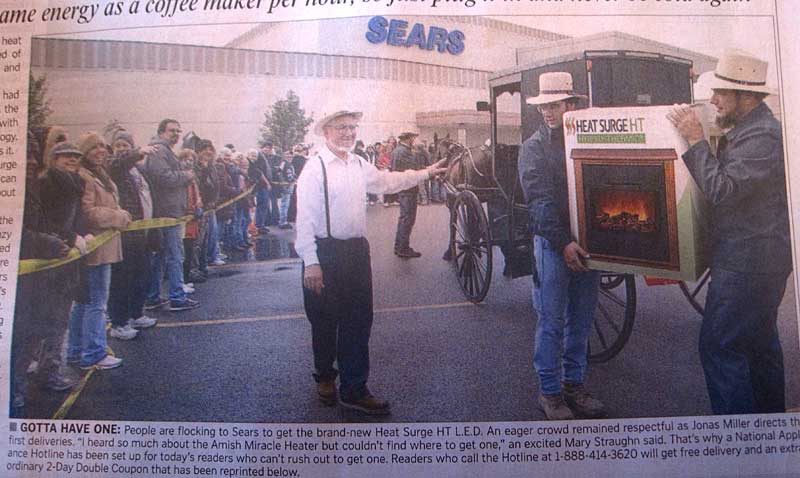
Right at the top is the dumbest staged photo I think I've ever seen: a line of people in a Sears parking lot, standing behind yellow caution tape, dressed in their winter coats as they wait for a crew of supposedly Amish men to unload a few Heat Surge boxes out of the back of a horse-drawn buggy.

Give me a break.


The idea that a huge retailer like Sears takes deliveries from guys in buggies is laughable. The implication that the men in the photo are actually Amish or the people behind the caution tape are customers is equally silly. The only true thing in this photo is the fact that Sears is now selling the heaters; they should be ashamed, in my opinion.

The ad's text is full of the same type of absurdity. The breathless copy crams in so many pseudo-technical terms it's like a Monty Python script. "This is the revolutionary Heat Surge HT L.E.D., the first-ever appliance with Hybrid-Thermic™ heat technology. Hybrid-Thermic heat is an engineering genius so advanced, it actually uses a micro-furnace from the Coast of China and a thermal heat exchanger to perform its miracles. The thermal heat exchanger acts like the rays of the sun to heat you, the kids, the pets and everything else. The micro-furnace then heats all the surrounding air.... In fact, it actually produces Ortho-Thermic™, bone-soothing heat."

Oh, wow, a micro-furnace from the Coast of China! We all know everything that comes from China is good. And a hot LED -- where do they get those? The reason LEDs are energy-efficient is because they don't put out heat. And how many more ™ marks can they use on made-up words like Ortho-Thermic?

A new section of the ad has the bold headline "A Consumer Best Buy," followed by the claim that it "boast[s] an overwhelming Consumer 'Best Buy' on the HeatReport.com website." This is clearly supposed to make readers think of Consumer Reports -- the venerable consumer watchdog, which has a history of giving the Heat Surge / Amish heaters a less than warm review. But HeatReport.com is a website created by Heat Surge -- it's not an independent review -- so it's full of glowing recommendations. Big surprise.

The ad refers again and again to a "double coupon" deal, but it never says how much the single coupon is for. The heater costs $398 if you call in the next 24 hours; it's $547 after that, although I had to read it about three times to find that price listed. The only difference from their past ads is that shipping and handling are included with this "coupon." To make up for that decrease, though, the $398 price is almost $100 more than they were selling heaters for last year. Maybe the price went up because of all that revolutionary technology from China.

The ad claims the heater uses $.09 of electricity per hour in "standard mode." It then says "yet it produces up to an amazing 4,606 British Thermal Units (BTU's) on the high setting." No mention of  how many BTUs it puts out on the standard setting, or how much electricity it uses on the high setting. (The Heat Surge website lists the standard setting as putting out 2,303 BTUs, so I would infer it costs $.18 per hour to run it on the high setting.) Note that 4,606 BTUs is less than the amount of heat put out by a 1,500-watt heater, and less than was put out by the version Heat Surge was selling last year. (4,606 BTUs equals about 1,350 watts.)

Just remember these facts:
  • The Amish heater costs $398. Electric heaters that put out comparable amounts of heat can be had for under $100. Even ones that come in furniture-like cabinets cost substantially less than $398.
  • $.09 per hour will be added to your electric bill whenever the heater is used in standard mode. If you run it 24 hours a day, that's $2.16, and if you do that for a month it adds about $65 to your bill. If you run it on high, the electric charges will double. Will your gas or oil bill be decreased by more than that? Natural gas creates cheaper heat per BTU than electricity -- 60 percent cheaper, according to Consumer Reports, so that seems doubtful to me.
______________

Here's some background on the Universal Media Syndicate and Arthur Middleton Capital Holdings, the company behind the Heat Surge ads.

Saturday, February 20, 2010

Apatrim - Scam or Science?

Here's the latest from the Universal Media Syndicate and its partner company Patent Health: An appetite suppressant named Apatrim. Their full-page ad in yesterday's Star Tribune had all the usual UMS trappings (it looks like a newspaper page, has lots of quotes from possible experts, and dangles an act-now! deadline to get a special deal):

Full page ad for Apatrim

My analysis:
If you're looking for a weight-loss supplement that seems somewhat promising in two very small studies that have not been reviewed by the FDA, and you want to pay more than you would have to for another product that has the same active ingredient, go right ahead.

Apatrim's active ingredient (not mentioned in the ad, although it does tell us that it's "all natural," of course) is from a succulent plant called Caralluma fimbriata, which is native to the Indian subcontinent. The vague and under-referenced Wikipedia page about the plant says that it is well-known as a food to eat during starvation times because it will suppress the appetite.

I believe there are several serious questions about the Apatrim ad, the product in general, and its pricing.

Product

The ad says the product is made from a "patented process to make sure that the pill has the same effects as the plant." According to Sybervision, another website that reviews supplements:

there is only one type of patented caralluma fimbriata and that is Slimaluma. Now, because Apatrim chooses not to show you their product label on their official website I had to go digging around the internet to find one. This is what I found:

Close up of ingredients, saying it contains 500 mg of Caralluma fimbriata extract
If Apatrim really contained Slimaluma, it would have to be on their label - But it isn't. And that makes me wonder if Apatrim really contains Slimaluma at all. I would venture to guess no. Slimaluma is patented and has been clinically tested. If Apatrim is claiming the same results of the Slimaluma studies they are pretty misleading.
Slimaluma has been tested twice, once in India with 60 subjects taking the product over 6 months, and once in the U.S. with 26 subjects using the product for 4 weeks. Both claim to be double-blind, placebo controlled designs; the Indian study split its subjects between the two groups evenly; the U.S. study had only 7 people in the placebo group.

On slimaluma.com, the Indian trial is reported in general and a publication citation is given. There is a PDF on that page that adds a little more detail ("Statistically significant reductions were recorded in all key indicators of weight-loss") without data tables. The PDF refers to Exhibits, but they are not included.

Importantly, though, the abstract of the Indian study, provided on two other credentialed medical sites, gives a different impression of the results. While it's clear there were some statistically significant effects of the supplement, weight loss was not one of them:
Waist circumference and hunger levels over the observation period showed a significant decline in the experimental group when compared to the placebo group. While there was a trend towards a greater decrease in body weight, body mass index, hip circumference, body fat and energy intake between assessment time points in the experimental group, these were not significantly different [emphasis added] between experimental and placebo groups.
So the people taking the supplement said they felt less hungry, and for some reason their waists got a bit smaller, but they didn't actually lose weight significantly more than the placebo group.

The U.S. study, conducted over just 4 weeks with 26 people (only 7 in the placebo group), appears to be the one that's mentioned in the Apatrim ad. The ad includes graphs that indicate 83 percent of the subjects taking the active ingredient lost weight, and that the average weight loss was 4.5 pounds, vs. about .4 for the placebo group:

Graphs from the ad, showing the numbers described above
Wow, that sounds good, even though the study is small, right?

What's the catch? There's no citation of where the study was done, who did it, or a chance to review it to see if the ad is reporting it accurately, or if it even exists. As the site, dietpillcritic.com puts it,
First off, the clinical study cited on Apatrim’s website done on Apatrim appears to have been an in-house study. They mention a doctor’s name, but no reference to the actual study so that we, or anyone, can verify those claims and the viablility of the study. Real studies will be well documented to be referenced later by others (and hence have to pass the scrutiny of others).
Perhaps we should assume it's the same U.S. study described on the Slimaluma site as being conducted at the Western Geriatric Research Institute in Los Angeles, which has the same number of participants. This research was presented at a conference in 2004; no accessible version is linked. The summary of results says "every patient taking the active ingredient lost significant weight" although, again, no statistics are given. The doctor supervising this test, Ronald M. Lawrence, appears to be working for Slimaluma, because he makes presentations on their behalf at product exhibitions.

Based on the information provided about both the U.S. and Indian studies, I would say that neither Apatrim nor Slimaluma meets a reasonable standard of evidence for their claims of weight loss (where reasonable means significant results in a study that is peer-reviewed and replicable).

Pricing

Slimaluma can be bought many places, including amazon.com for prices like $14.98 (or less in larger quantities). Apatrim is more expensive:
  • $24.99 for 60 capsules at my local Walgreens. This would be subject to sales tax, which would add a bit under 7 percent to the price, for a total of $26.74 per bottle.
  • I was quoted a similar base price when I called during the advertised 48-hour deadline: Buy one bottle at $29, get two bottles for $19 each (totaling $67 for the three bottles), plus shipping of $7.85 = $24.95 per bottle. Thanks for saving me the sales tax, I guess; glad I called in before the deadline! (Of course, if I wanted to buy just one bottle like I could at Walgreens, it would cost me $36.85.)
  • On the website, I found the same three-bottle price of $67 plus $7.85 shipping with no deadline... and the website helpfully adds a 3 percent up-charge to get a BuySafe Bonded money-back guarantee. (When I called about pricing, I was told there was a money-back guarantee without any extra charge.)

    BuySafe Bonded added another $2.01 to my bill, making the per-bottle price $25.40. The BuySafe Bonded up-charge is actually optional, but I didn't realize that when I looked at the shopping cart:

    Screen snapshot of the Apatrim shopping cart, showing the BuySafe Bonded logo and a box with a green check mark, accompanying a charge of $2.01

    Would you realize that green checkmark was something you could unclick? It looks like a graphic to me. In my opinion, it adds an extra touch of sleaze when options like this are set to "opt out" instead of "opt in."
All of this reinforces my initial thoughts:
  • Apatrim and Slimaluma look, at best, promising in the two very small trials, which have not been reviewed by the FDA.
  • Apatrim is significantly more expensive (about 60 percent more) than the Slimaluma supplements available online.
Like they say, if it sounds too good to be true, it probably is, unless there's real proof to the contrary.
________

For a list of my past writing on the Universal Media Syndicate, Arthur Middleton Capital Holdings and their many partner businesses, check out this post about the cease and desist letter I received from them.

Wednesday, January 21, 2009

Obama Mania -- at a Price

When it comes to both kitsch and sucker-born-every-minute examples, "commemorative" objects are a category all their own. As I began to see the Obama inauguration commemoratives being advertised, I put them in a pile. Here are a few:

Obama photo collage
Commemorative photo collage with "24kt gold-plated solid bronze medallions" from the Danbury Mint. Listed at $99 plus $9.90 shipping and handling (payable in three monthly installments).

Illustration of Obama with other items around it
A "Collector's Folio" from PCS Stamps & Coins, sporting an uncirculated Illinois State Quarter, a 24kt-gold, electroplated Obamamedal, a one-day-only postmark from Inauguration day, and three "mint-condition" stamps -- arranged around a "specially commissioned portrait." All this for $59 plus $4.50 shipping and handling (payable in two installments).

Plate with illustration of Obama on itCommemorative plate from Telebrands. Listed as $19.99 plus $6.99 shipping and handling. (Oddly, if you send them a check, however, the cost including handling is $33.97.) This one comes with a special bonus -- a U.S. Mint commemorative President Washington coin.

I'm not critiquing buttons or t-shirts, you'll notice, and also no items that have a hint of cleverness. No, these are all straight-up kitsch -- plaques and plates, primarily.

Full page ad hawking Obama coinsThe prices on these items are silly and outrageous, but they're clearly labeled, and so if someone pays the money, they know what they're getting.

Not so the most recent pitch I saw in today's Star Tribune from the hacks at Universal Media Syndicate and the World Reserve Monetary Exchange. Their full-page ad talks a whole lot about a "free" Obama presidential quarter, while what it is actually selling is a "solid Silver coin for forty-nine dollars" in a "handsome Presidential Display" (i.e. box). If you order that item, you get the "free" quarter with it.

Close up of the ad, showing the price listed as forty-nine dollars
Note the lack of numerals or dollar signs in that price (suddenly, $49 = forty-nine dollars), a technique they also use in their ads for the Universal Health Card. I read the coin ad thoroughly without seeing the price until I looked more carefully. (The other item shown in the ad, a set of five Obama coins, is never given a price at all.) This obfuscation of the price is a common tactic in UMS ads.

Other common UMS tactics used in the ad:

  • The scare tactic of limited time ("all those who beat the 48-hour order deadline")
  • Inclusion of a map dividing the country up into territories with supposed different access to the product
  • Provision of a "claim code" that makes the product look more limited and special
  • The use of words like "authorized," "restricted" and "exclusive."
Close up of the coinThe copy says that UMS makes no promises about the coins appreciating in value, but at the same time it recounts numerous examples of other items that have appreciated in value, implying the coins could do the same. There is absolutely no possibility these coins will have any special value -- there are too many of them. (The reason Teddy Roosevelt campaign buttons are worth $3,000 is because there are not very many of them. Remember all those Beanie Babies you see for sale for $1? The ones everyone thought would finance their retirement? Yeah. Like that.)

As anyone who has read my past posts on UMS knows, I find the company and its products revolting. Their Obama coin offer sinks to a new low. Perhaps the new Obama administration will do something to protect gullible consumers from the UMS and its products.

Tuesday, July 21, 2009

LifeLock Ads -- Curiouser and Curiouser

Full page newspaper ad for LifeLockLast Sunday's Star Tribune business section included this full-page ad for LifeLock. In case you haven't heard of it, it's a company that guarantees it can prevent identity theft, and its CEO is known for publicly disclosing his Social Security number to prove how iron-clad the service is.

I was vaguely aware of LifeLock (I think from an ad that was in Parade magazine a while ago), and wondered if it was a legitimate product. I looked into it a bit at the time, and decided it seemed like it was basically on the up-and-up, and so I left at that.

This recent ad caught my eye, though, because its layout is almost identical to the ads done by the Universal Media Syndicate.

For instance, compare the layout above to this one for the Universal Health Card (ignore the pink boxes -- those are from me):

It has the same right-dominant image at top, photos of "real people" across the bottom with their stories marked off by a square bullet, and a call to action box about two-thirds of the way down the right side of the page, complete with Promo Code and two different phone numbers to call depending upon whether you want single and multiple coverage.

There are even similar little icons for each phone number (although the "padlock man" icon has been used by LifeLock before this ad).

So either LifeLock is imitating the successful formula of the UMS, or possibly they've actually hired UMS to produce the ads.

Looking into LifeLock a little further, I discovered they weren't quite so up-and-up as I had thought. They do offer an actual service (which costs $110 per year), but it's something you could do yourself for free.

Basically, the same 2003 law that brought us each a free credit report per year also made it possible for us to put a fraud alert on our credit reports so that no one can open a new account in our name without checking with us first. Jeez, you say, that sounds like something that should be required in the first place. But it's not, you see, because that would slow down the credit bureaus and therefore cost them money, so they didn't let it become law.

What LifeLock does is put one of those fraud alerts on your reports, and then renew the hold every three months. As security expert Bruce Schneier explained it in Wired, you do get something for your money from LifeLock, but in his opinion, it's not worth it. He writes, "LifeLock's business model is based more on the fear of identity theft than the actual risk."

But just because it's not worth the money, doesn't mean people aren't doing it, which angers the credit bureaus. According to Schneier,

This service pisses off the credit bureaus and their financial customers. The reason lenders don't routinely verify your identity before issuing you credit is that it takes time, costs money and is one more hurdle between you and another credit card. (Buy, buy, buy -- it's the American way.) So in the eyes of credit bureaus, LifeLock's customers are inferior goods; selling their data isn't as valuable. LifeLock also opts its customers out of pre-approved credit card offers, further making them less valuable in the eyes of credit bureaus.
So the credit bureaus and others sued LifeLock, claiming they are misusing the law that allowed fraud alerts. The alerts, they argue, were only meant to be used after a person's wallet had been stolen, or their house broken into. Schneier counters that by saying, "the text of the law states that anyone 'who asserts a good faith suspicion that the consumer has been or is about to become a victim of fraud or related crime' can request a fraud alert. It seems to me that includes anybody who has ever received one of those notices about their financial details being lost or stolen, which is everybody."

Despite that, the credit bureaus recently won their suit, and so I guess LifeLock's whole business model has been thrown out the window.

Which leads me to question what the point of the recent ad was. It ran weeks after the lawsuit was decided. The text does emphasize several times that the service is for people who "have a good faith suspicion that you are at risk of identity theft," so perhaps that's LifeLock's way of trying to get around the recent ruling.

If there's one upside to all of this, it's that it may make more people aware of their right to put a fraud alert on their credit reports. If you want to do it, this is how, according to the site lifelock-scam.com:
Placing your own fraud alert takes a few minutes and costs nothing. You only have to place it with one of the [credit] bureaus as by law the one you place it with must inform the other 2.

To find out just how easy it is simply ring or write to any of the following credit bureaus to request a fraud alert to be placed on your credit file:

TransUnion: 1-800-680-7289; Fraud Victim Assistance Division, P.O. Box 6790, Fullerton, CA 92834-6790

Equifax: 1-800-525-6285; P.O. Box 740241, Atlanta, GA 30374-0241

Experian: 1-888-EXPERIAN (397-3742); P.O. Box 9532, Allen, TX 75013

An ‘initial’ fraud alert is designed to be used if you feel you are at risk, so if asked for a reason you might mention the wallet or purse that you lost or the ‘post that has been going missing.’
Do it today, if only to annoy the credit bureaus!

Sunday, February 22, 2009

If It's Not One Thing, It's Another

Newspaper page with full-width closeup photo of Obama looking downward. Red and black Target ad goes full width below the photo, with Thing 1 and Thing 2 bounding around promoting Storytime at TargetWe all know newspapers are hard up for money, laying off staff, going bankrupt, and so on. This leads to a number of unintended consequences, like the increase in ads from advertisers of last resort like the Universal Media Syndicate.

It also leads the papers to put ads in places they never have before -- such as the front page, or right smack dab in the middle of a story, as the Star Tribune did in today's paper.

My jaw dropped when I saw the page. (Click on the image to see it larger.) It is wrong on so many levels:

  1. The juxtaposition of photo and ad makes it appear as though Obama is looking at the ad, rather than contemplating a difficult decison.
  2. The ad's placement breaks up the page so that it's not entirely clear the photo and headline above the ad go with the story below.
  3. And most egregiously, the specific ad is beyond inappropriate. The antics of Dr. Seuss's Thing 1 and Thing 2 in the book The Cat in the Hat are the essence of chaos. No matter how much the fish in the pot tries to advocate for order, Thing 1 and Thing 2 run roughshod over everything in the house.
Wait a minute. Come to think of it, perhaps this is a sly editorial comment from the Star Tribune. Maybe the paper is making an analogy to our current economic situation!

Maybe George Bush and previous administrations are the Cat in the Hat, who have loosed the forces of economic chaos and deregulation.

Thing 1 and Thing 2, relabeled Bank 1 and Bank 2
Maybe Obama has a handy net to use so he can catch the miscreants before mother comes home. Let's hope so.

And then perhaps the Cat in the Hat will reappear with his magic machine to help us kids clean up the mess.

Hmmm. Guess the analogy only goes so far.

Sunday, January 30, 2011

Find Out More About SmartLean and Fucoxanthin

A new full-page ad in today's paper is selling a pill called SmartLean, which is said to speed weight loss, particularly by increasing metabolism and burning fat.

Full page ad for SmartLean with Fucoxanthin
I'm not going to go into details about the many problems I see with the ad itself (no price is given for the product, it imposes a scarcity deadline to cause us to act now!, and it's designed to look like it's part of the newspaper rather than an ad in the first place -- the usual style of its creators, the Universal Media Syndicate).

But I will say this:

The active ingredient is Fucoxanthin, which comes from seaweed. If you're interested in buying this product, shop around on the price.

Don't be lulled by the information the ad gives about two clinical trials of 151 people. Those studies were paid for by businesses with a financial interest in seeing them succeed, and this type of incentive has often resulted in skewed results in the past. According to fitness coach Tom Venuto,

...even when a single study shows what seem like promising results, I always want to see it replicated by an independent (unbiased) research group before I would ever recommend it. It's astonishing to see how many supplement-company sponsored studies are never replicated by any other research group. Or, other research groups refute the findings of the first study after addressing flaws in the original study design.
Take that little footnote at the bottom of the ad to heart: The statements in the ad "have not been evaluated by the Food and Drug Administration."

Thursday, October 18, 2012

How They Made Their Money

If you're dull-witted enough to believe you can make a million dollars a year by working only two hours a week, do you deserve to be protected from ads and companies that exploit your gullibility?

Regular readers know that I've written frequently about deceptive advertising, and I generally think government has a role in making sure ads and products are reasonably honest. In my many posts about the Universal Media Syndicate, though, I've had comments from a few folks who think suckers who fall for their ads pretty much deserve what they get.

Sometimes I'm not sure myself what level of sympathy to muster, and yesterday's news in Mother Jones that a Romney/Ryan fundraiser would be hosted by Mike and Irene Milin made me think about this once more. The Milins have been investigated by more than two-thirds of our state attorneys general for their get-rich-quick schemes. According to MoJo, the couple has
amassed millions of dollars in personal wealth by pitching schemes to consumers on how to make bundles of money through real estate and via government grants and loans.... The Milins' companies promised quick and easy fortunes in real estate and "free" government money to anyone. But to pocket that windfall, customers had to attend the Milins' seminars and buy their instructional materials.
Real estate... well, I suppose it's possible you could make money at that without a lot of work if you were really lucky, so maybe dupes who fell for that scenario were not completely at fault, but it's hard not to lose some sympathy when the offer is based on outright stupidity:
In the 1990s, the Milins unveiled [their] National Grants Conferences. NGC claimed there were hundreds of billions of dollars in "free" government grants and no-interest loans. NGC's scheme worked like this: Customers were invited to attend a free seminar where an NGC pitchman hyped the wonders of free government money. But only with NGC's materials—which cost $999—could customers unlock the secrets to accessing this cash.
For the record, there are no pools of government money sitting around waiting to be handed out, and why anyone would think there are is beyond me.

Who are the people who believed this obvious fabrication enough to fork over a thousand dollars to get the list and instructions? Are they vulnerable adults who shouldn't be making their own financial decisions, like the young woman who was selling her personal injury settlement money to sharks for pennies on the dollar? Like my elderly relative who wired money to someone who called, pretending to be a young-adult grandchild in distress, even though Western Union warned him not to? Are there that many vulnerable adults with cash lying around to pay predators like the Milins, who seem to have amassed enough money to be able to spew it in chunks at every Republican candidate in sight?

But then again, how different is this, really, from Bernie Madoff's pyramid scheme, which took in hordes of supposedly sophisticated investors? Should there be no prohibition on that kind of activity, either, since his victims should have known better?

A long time ago, a friend who went to law school told me about a case he'd read that involved a drunk guy suing his city because he (the drunkard) had fallen into an open manhole. The judge found for the drunk guy, and his decision included these words: "A drunken man is as much entitled to a safe street as a sober one, and much more in need of it."

There are limits on how far we can push that analogy, but I think requiring honesty in advertising doesn't create a nanny state; it's part of creating a civil society. Any politician who takes money from fraudsters like the Milins (or money they helped to raise) is tainted, as far as I'm concerned.