
This is a follow-up post on the case of Koua Fong Lee, a St. Paul man who was convicted of criminal vehicular homicide after his Toyota accelerated beyond his control on a Twin Cities highway off-ramp, killing two people and injuring several others. He was released from prison in 2010 after serving more than three years of an eight-year sentence. He later was paid restitution by the state for his wrongful conviction and won a civil trial against Toyota.
A recent Radiolab broadcast gave a possible explanation for what happened to Lee's Toyota and the other Toyotas that accelerated uncontrollably. It has to do with cosmic rays, and it affects voting machines, too. Seriously.
Worth a listen.
__
If the Koua Fong Lee case is new to you, here are my past posts:
Let Koua Fong Lee go, March 2010
Deadly crashes, disparate justice, March 2010
Koua Fong Lee update, April 2010
Koua Fong Lee: Latest sentence shows unequal justice, April 2010
Rally to free Koua Fong Lee, July 2010
At the rally, August 2010
Koua Fong Lee is free, August 2010
Emily Gurnon, hero of the Koua Fong Lee case, August 2010
Looking sorry saves you three years in jail, April 2011
Koua Fong Lee graduates, May 2014
Sunday, July 14, 2019
Cosmic Rays, Seriously


Thursday, July 29, 2010
Rally to Free Koua Fong Lee: Monday Morning
Koua Fong Lee will finally get an evidentiary hearing this Monday. I hope this is just the first step on the way to a new trial, with him freed on his own recognizance in the meantime... or even better, that the county attorney will decide it's not in the interest of justice to refile charges against him.
Anyone interested in supporting Lee and his family is invited to a rally at 8:00 a.m. outside the courthouse, 15 W. Kellogg Street in downtown St. Paul. It's only an hour. Parking is available in the ramp across Wabasha (the Crowne Plaza Hotel).
The rally is organized by Trudy Baltazar, a Twin Cities woman who has been working to raise the profile of (and raise money for) Lee's case. She's got a hundred signs ready to share with anyone who wants one.
Baltazar doesn't know Lee. She's not a career organizer. She's just had enough of this clear example of unequal justice.
Earlier posts on the Lee case:
Let Koua Fong Lee Go
Koua Fong Lee Update
Koua Fong Lee: Latest Sentence Shows Unequal Justice
Thursday, August 5, 2010
Koua Fong Lee Is Free

After a four-day hearing, justice has finally been served. Judge Joanne Smith took 40 minutes to read her decision aloud, finding that new evidence and inadequate legal assistance in Koua Fong Lee's first trial both contributed to the need for a new trial.
According to Robert Brooks, a supporter of Lee's who spent each day this week in the courtroom as an observer, it was clear that a new trial would be the only outcome. Despite this, or perhaps because of it, the county attorney's office this morning tried one last-ditch ploy to maintain face by offering Lee immediate release, commuting his sentence to time served.
If he had taken the bargain, Lee would have kept a felony conviction on his record and would have been banned from driving for 10 years. I think it was a dirty trick on the part of the county attorney's office to make such an offer so late in the chain of events. It's almost as if they've watched too many episodes of Law & Order and they think that winning is more important than seeking justice. This isn't an episode of Deal or No Deal, people.
Lee turned them down, though, choosing to wait to hear what the judge had to say. It was a tense afternoon, knowing that he could have been free and that the judge could still send him back to prison.
But instead, Judge Smith took her legal duties as one would hope, despite the fact that she's the same judge who (inexplicably, in my opinion) sentenced him to eight years in the first place. Minnesota Public Radio's Tim Nelson reported that Smith's statement contained at least one admission of her own error in the original trial.
It was a dramatic chain of events as the day came to a close.
At about 4:45 p.m. today, news finally broke about the judge's decision. The Free Koua Fong Lee Facebook page was overflowing with well-wishes and questions as people tried to figure out what had happened. The judge's order meant he would be freed within the hour, but would still be subject to restrictions, as if he were on probation, while waiting for the new trial.
Then, just as Lee was released from custody, and was speaking at a press conference alongside his lawyers, the news arrived that Ramsey County Attorney Susan Gaertner had announced she would not refile criminal charges against him.
So he is truly free, and his name is cleared. Let's hope something has been learned from all of this.
__________
Minnesota Public Radio story by Tim Nelson
Saturday, March 12, 2011
Looking Sorry Saves You Three Years in Jail
Yes, I still think about Koua Fong Lee, especially when I see stories like the ones in today's papers: from the Star Tribune, Driver in Crash that Killed U Researcher Gets 5 Years; from the Pioneer Press, Driver in Fatal Crash Sentenced to Five Years.
In this recent case, a drunk guy was going 60 miles an hour on a Minneapolis city street (that's 3o mph over the speed limit, for those of you not from these parts). He ran a stop sign and smashed a car driven by Ethan Johnson and carrying Johnson's wife, father and stepmother. Johnson, a biochemist, musician, and avid bicyclist, was killed, and his father was severely injured to the extent that he can no longer work as a neurologist.
The drunk guy, Kevin Doerr, already had six criminal convictions, and had been prohibited from drinking, using drugs or driving (since he didn't have a license). He fled the scene of the accident.
Okay, so we all remember that Koua Fong Lee was sentenced to eight years, even though there was no credible evidence of negligence, let alone intent, and he didn't flee the scene. What sentence did Doerr, with his record and clear criminal disregard for human life, get?
Five years.
The only thing that can explain this disparity, in my opinion, is cultural bias. Doerr received less than the maximum sentence, according to the Strib, because "Doerr took responsibility for his actions." Not only that, but he'll be allowed to serve an additional two-year sentence for an unrelated assault conviction concurrently.
Koua Fong Lee didn't "take responsibility for his actions" because he knew he wasn't guilty. And he looked impassive at trial, instead of emotional and very sorry for the accident, because that's how he, as a recently arrived Hmong male immigrant, grew up behaving. Hmong men aren't supposed to show emotion, but be in control.
I am not necessarily arguing that Doerr's sentence is too short in an absolute sense. I don't know what the sentence for vehicular homicide should be.
But I do know that I wonder how the judge in Lee's case could have sentenced him to eight years. She's the same judge who later released him, and she seemed logical enough in that decision. But I hope the lack of logic in her original sentence haunts her every day, and reminds her of her unintended bias.
That bias was enough to send Koua Fong Lee to jail for three more years than a stone-drunk jerk with a record.
Sunday, March 7, 2010
Let Koua Fong Lee Go

The Koua Fong Lee car crash in St. Paul a few years ago was heart-rending. In it, Lee's 1996 Camry accelerated off I-94 onto a crowded off-ramp where dozens of cars were waiting for a light. He was going 80-plus miles an hour when he finally stopped by colliding with the Adams family's car, killing or severely injuring everyone inside it.
Why did he do it? Lee's own family was in his car as they headed home from church, so clearly it wasn't intentional. Drugs and alcohol were quickly eliminated as factors. Everyone homed in on the fact that Lee was a relatively inexperienced driver, so he must have had his foot on the gas, even though he insisted he was pushing the brakes for all they were worth.
Now, of course, they're pulling Lee's car out of the impound lot to see if it has the Toyota acceleration problem. (See the Star Tribune article here.)
But my question is, Why was Lee found guilty of criminal vehicular homicide and sentenced to 8 years in prison in the first place? Everyone agreed he didn't do anything on purpose, and negligence wasn't even the issue, as far as I can tell. What good does it do to put someone away, on the state's tab, in these circumstances?
I know that people were killed. But does ruining this guy's life and that of his young family (wife and four kids under 10, now on welfare) really compensate the survivors of the dead? The jurors interviewed for the Strib sidebar make it sound as though they couldn't consider anything but prison time: "If we had gone with a lesser offense, it was basically 'a slap on the hand. It was almost nothing,' he said. 'Yet we didn't want him to go to prison [for years].' "
The justice system is not supposed to be about revenge. It's supposed to prevent further crime and, ideally, rehabilitate the guilty. Neither purpose is served in this case. If it were my family killed in similar circumstances, I think I would say the same thing.
Wednesday, August 11, 2010
Emily Gurnon, Hero of the Koua Fong Lee Case
 We've all heard about Koua Fong Lee's pro bono lawyers, and about Trudy Baltazar who organized the protests, and even about BadAndy, a California man who set up the Free Koua Fong Lee Facebook page. And, of course, Lee himself and his wife, Panhoua Moua, who never gave up.
But I had absolutely no awareness that Pioneer Press reporter Emily Gurnon is largely responsible for the fact that Lee is a free man.
Gurnon covered the original trial in 2007 (a snippet of one of her articles from that time can be seen here). According to her colleague Ruben Rosario in today's PiPress, Gurnon never forgot the case after the trial ended. And it was Gurnon who contacted attorney Brent Schafer to ask if he had heard about the cases of unintended acceleration among Toyota drivers.
MinnPost's David Brauer followed up on Rosario's column, checking with Schafer to ask for his recollection of Gurnon's actions. Brauer writes, "Schafer says he was vaguely aware of the Toyota recall news as it swirled last winter, but he was in trial when the news hit so didn't really focus on it. Gurnon called his office three times that week; he finally called her back on a Friday afternoon."
Gurnon was also a guest on the local PBS affiliate TPT2's show Almanac on Friday night after Lee was released. I caught part of the interview, which was when I first realized I had completely missed how this story came to reach the spotlight it deserved.
In January or February this year, Gurnon wrote about Lee's case, raising the issue of Toyota's problems. (I don't know exactly when, since the Pioneer Press has the terrible habit of removing stories from its own site after a few months.) But it was well before I started noticing the stories. I didn't write about it until March 7 -- probably after I'd seen several stories, and the Star Tribune had also followed her lead. Here's one of Gurnon's early stories (from February 14, reposted to a Hmong community website), though not the first one.
Thanks to Emily Gurnon for doing her job well, and for not backing down despite negativity from the County Attorney's office. According to Rosario, they tried to tell her she was biased. He wrote, "A senior attorney in the [County Attorney's] office called Gurnon and essentially reamed her about her 'biased' coverage. I know this because I sit right in front of Gurnon. She handled it in a far more professional manner than I would have done."
If Emily Gurnon is biased, I hope we all are similarly biased in favor of justice.
Monday, August 2, 2010
At the Rally

I did attend the rally for Koua Fong Lee in St. Paul this morning. About 100 people held signs and circled outside the door to the court house while the morning sun began to beat down upon us.
It was interesting to see folks who are not veteran organizers put something like this together. In this case, particularly, there is a range of people involved -- Lee's family members, Hmong elders and community leaders, members of the Trice-Adams family and their friends (whose loved ones were killed in the accident), and people who know only what they've read in the paper but want to share their outrage.
There were some last-minute discussions among these groups to get speakers in order and decide who was running things, but it seemed to work out.
We walked and chanted a bit under the watchful eyes of half-a-dozen camera crews and journalists. (You can tell the on-camera people because they're dressed better and are more likely to be female.)
I'd estimate that 50 to 60 percent of the rallyers were Hmong, a few were African-American, and the rest were white. But it seemed to me, as I circled around the flower planter that provided the rally's focal point, that almost half the white demonstrators were called out of the picket line to be interviewed by the assorted media reps, while almost none of the Hmong or black demonstrators were. Hmmm.
This little boy's T-shirt made the terrible situation even more real for me. I just hope Koua Lee can get home to his family as soon as possible.
Monday, April 5, 2010
Koua Fong Lee Update
Today the Star Tribune ran an editorial that essentially said the same thing I wrote a month ago about Lee's case, challenging the illogic and injustice of his sentence. It was a fine piece of writing, containing this slap in the face:
L.C. Wesley Armstrong...was convicted last year of second-degree manslaughter after he began arguing with a pregnant woman in the passenger seat of the car he was driving and took his hands off the steering wheel to grab her. The car flipped and crashed, killing the woman. Armstrong also was convicted of first-degree burglary in 2009.The same issue contained an interview with Lee, which closed with these words from him:
For those convictions, Armstrong spent a total of four months in prison.
[Koua Fong] Lee, now 32, had no criminal record, no prior driving offenses, no drugs or alcohol in his system and steadfastly maintained that he'd pumped the brake as his car rocketed through the intersection. Prosecutors and Lee's defense attorney concluded that he'd mistakenly hit the gas pedal instead. For this, Lee is serving eight years in prison.
Shown the newspaper story about Armstrong's four-month sentence, Lee grew quiet and looked around the Lino Lakes prison conference room in bewilderment on Thursday.
Had I known this was going to happen, I would have stayed in the refugee camp. If I had known lives would be lost and my wife and kids separated from me, I'd rather have lived in a refugee camp. I would like the victims' family to know that this was not on purpose, not intentional. I tried to step on the brake. I tried to stop the car. It just didn't happen.Finally, a commenter to my earlier post left the address of a Facebook page in support of freeing Koua Fong Lee.
Friday, April 30, 2010
Koua Fong Lee: Latest Sentence Shows Unequal Justice
As you know by now, Koua Fong Lee was convicted of criminal vehicular homicide several years ago, and has been in prison on an eight-year sentence ever since (see my earlier post). He wasn't drunk, texting, or on his phone, tried to stop (his family was in the car!), but either his 1996 Toyota malfunctioned or, possibly, he was stepping on the gas when he thought he was stepping on the brake.
Three people died and the Ramsey County attorney thought someone had to pay for it. The jury, unfortunately, agreed. There's new evidence that shows Lee definitely had his foot on the brake at the time of impact, as he said, and possibly mechanical findings about a malfunction of his cruise control.
Minnesota has many examples of people who were clearly negligent who got much lighter sentences than Lee. A new one was just recently decided, as described in the Star Tribune story Teen Charged in Lakeville Crash that Killed 3 Family Members. In this case, a 17-year-old boy with a brand-new provisional license was driving at night without his headlights when his pickup truck crossed the center line of a highway and destroyed a car containing three generations of a family (grandmother, daughter, and granddaughter).
While the teen, Brandon Iams, has not been found guilty yet, the news story reports about how he will be charged: A grand jury returned a finding of careless driving, rather than criminal vehicular manslaughter, the crime Lee was convicted of. Lee was on trial for both charges, and the jury went with the more severe crime because, as one juror put it, "If we had gone with a lesser offense, it was basically 'a slap on the hand. It was almost nothing,' he said. 'Yet we didn't want him to go to prison [for years].' "
I don't have an opinion of whether Iams should be charged with manslaughter or not. But I do believe that his actions are clearly more negligent than anything Lee did. According to the Star Tribune, "A witness saw the truck without headlights on, heading west on County Rd. 50... The driver pulled into a turning lane at Ipava Avenue, signaling a turn. But instead of turning, he returned to Hwy. 50, where he entered the eastbound lane and crushed the front end of [the family's] sedan."
What is the standard for criminal negligence? How do the facts in Lee's case (even as known in 2006) meet that standard, if the ones in Iams' case don't?
The maximum sentence Iams faces is 90 days in jail and a $1,000 fine. While Lee sits in prison for another four years.
It's time for a new trial, or better yet, clemency or a commuted sentence for Koua Fong Lee. Let him go back to his wife and four young children.
Wednesday, October 26, 2011
Minding the Reckless Driving Gap
Is there a gap in our laws when it comes to inattentive driving? Where is the line between not paying enough attention and obvious recklessness? And where is the next line, between recklessness and criminal negligence? What types of penalties should be possible for each one?
The Koua Fong Lee case was galvanizing for me. How could a jury, let alone a judge, find a man guilty of criminal negligence when he was trying to stop his runaway car?
Lee, thank goodness, was finally released after serving several years in prison. While he sat behind bars, other Minnesotans who were clearly negligent and others who were only reckless or inattentive were sentenced to less time or no time at all.
Dakota County prosecutor James Backstrom is agitating for a change in the law to create a new gross misdemeanor offense of careless driving resulting in a death. It would include jail time of up to a year.
During Backstrom's decades in office, he's seen the effect on the families of victims, and wants a more stringent sentencing option. He and others, such as state Rep. Pat Garofolo, compare the proposed law to the change that took place over time in our thinking about drunk driving. "A drunk driver rarely means to injure or kill someone," Garofalo is quoted in the Strib story as saying. "We still punish them. This is a problem that needs to be fixed and it needs to be fixed now."
Michael Friedman, writing an op-ed in response to the proposed law, made a number of excellent points. The title of his op-ed, Tough sentences may feel good, but aren't necessarily a solution, gives the gist. "...if a 90-day sentence is changed by a law to a one-year sentence, who is to say that victims such as the ones pressing Backstrom would be satisfied? Why not two years? Then someone will later decide one or two years is hardly enough; how about five? Sentencing based on the raw emotions of victim pain is not a good basis for policy."
Friedman isn't buying the argument that inattentive driving can be decreased the way drunk driving has been by criminalizing it and increasing penalties, either. "Would we prevent poor driving by criminalizing it more substantially if a death results? How many of us have veered into lanes at the wrong time, gotten distracted by something in the car, taken a turn too fast, not seen a car stopping in front, and so on? Sure, we're infuriated when others who do so put us at risk, but to raise the stakes in sorting through which bad driving behavior is willful and which is just stupid or accidental is not what we want to spend our criminal-justice dollars on. It is not in the long run going to help the emotional recovery of victim families, or improve driving generally."
Friedman closes by calling for a Restorative Justice approach to these cases.
A few days later, Backstrom responded to Friedman in his own op-ed. He insists that "The proposed legislation would apply only to drivers who cause the death of a person while taking unreasonable risks such as speeding, texting or talking on a cell phone while driving, or falling asleep behind the wheel."
That list is pretty interesting. Speeding (how many miles per hour?) or falling asleep are equated with texting or talking on your phone. Hmm. I wonder where some of the recent cases would fall within Backstrom's list of reckless behaviors. Would the young driver who didn't have his lights on at night and mistakenly crossed the center line, but was only charged with misdemeanor careless driving, fall under this new charge? On the other hand, would Koua Fong Lee have been found guilty of the lesser charge, instead of the felony he was convicted of, resulting in only a year in jail instead of eight?
Cathy Waldhauser, writing a letter to the editor in response to both op-eds, had the final word:
SAFE DRIVINGWaldhauser's point is important. As a driver, I know there are countless times when I have been distracted in a minor way, only to find myself in a dangerous situation. In all of those instances, I have been lucky enough not to have a collision.
Why punish only the unlucky ones?
This is in response to recent proposals to increase the criminal penalties for careless driving resulting in death, and to two excellent commentaries from James Backstrom...and Michael Friedman....
I have been troubled throughout this discussion by the notion that driver-caused accidents resulting in death should be punished far more severely than those that do not result in death, while the actions themselves remain perfectly legal.
If driving while texting or talking on the phone is a mortal threat to others, which it clearly is, then that deliberate action should be illegal and punishable.
Few drivers purposely set out to cause an accident or death, so intent is not a factor. Distracted drivers who do cause an accident were simply unlucky.
Why should only they be treated as criminals while the rest of us are free to gamble with others' lives on a daily basis?
Let's penalize and reduce the controllable activity, not just the random result. My unscientific observation is that 90 percent of erratically driven cars have a driver on the phone -- and they are everywhere.
Outlawing talking on a phone or texting while driving is probably a good idea. But it won't change behaviors related to other seemingly innocuous activities, like reaching for something that dropped to the floor or changing the radio station. And there doesn't seem to be anything we can do to make sure people turn on their lights at night and especially at twilight, judging by all the people who ignore me when I try to signal to tell them they're driving in the dark.
Maybe we just have to recognize that human beings moving around in two-ton metal boxes at incredible speeds are inherently dangerous, and there's only so much that can be done from a legal standpoint to make everyone as safe as possible.
Sunday, May 18, 2014
Koua Fong Lee Graduates
A piece of excellent news: Koua Fong Lee graduated from Inver Hills Community College in the past few days.
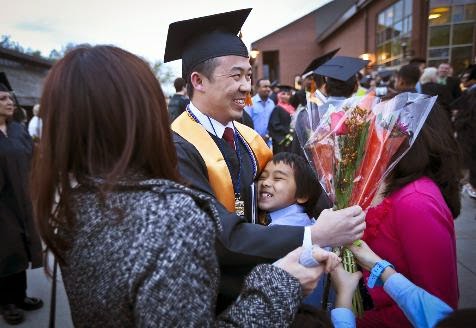
A bit less than four years after he was released from a wrongful prison sentence, Lee -- a father of four who came to the U.S. with little English -- has taken a big step in his life and in the life of his family. Congratulations!
Star Tribune photo by Renee Jones Schneider. Thanks to columnist Jon Tevlin for covering Lee's graduation.
Thursday, September 16, 2010
As RNC 8 Trial Approaches, Some Charges Dropped
 According to the Twin Cities Daily Planet, charges against three members of the RNC 8 have been dismissed. Monica Bicking, Luce Guillen-Givens, and Erin Timmer are off the hook; another defendant, Erik Oseland, took a plea deal a few weeks ago.
Max Specktor, Rob Czernik, Garret Fitzgerald, and Nathanael Secor still face charges of conspiracy to commit riot. Their trial is scheduled to start October 25. The RNC 8's attorney, Bruce Nestor, says the remaining four have also been mailed proposed plea agreements. The Daily Planet paraphrased Nestor as saying the dismissals and pleas are being offered because the county has decided the trials would be "costly and time-consuming." Nestor had this to say:
"I don't think that Susan Gaertner should be allowed to hide behind this kind of justification," said Nestor. "For two years she and Bob Fletcher have claimed that the RNC Welcoming Committee was a criminal enterprise. It is absolutely shameful to charge them with conspiracy and terrorism charges and then dismiss those charges two years later because the trials are going to be time consuming. They [Gaertner and Fletcher] should stand up and say they were wrong."Remember, this case is being prosecuted by Susan Gaertner, who showed such great judgment in the Koua Fong Lee case, and was investigated by Bob Fletcher, who (I hope) will be Ramsey County sheriff for only a few more months.
Tuesday, March 16, 2010
Deadly Crashes, Disparate Justice
The Star Tribune's recurring articles on drunken driving, called Smashed, have been a don't-miss part of the paper lately. From frequent briefs focusing on one individual with repeat offenses to the recent story on Ramsey and Anoka counties' successes with repeat offenders, it's always eye-opening.
Today's paper carried a related story that had me shaking my head, particularly in light of the recent story of Koua Fong Lee, who was convicted of criminal vehicular homicide and sentenced to 8 years in prison despite the fact that he was clearly not culpable in the deadly accident.
Contrast Lee's sentence with that of Kristen Driscoll, who was so drunk that she passed out while driving, hitting and killing a man who was sitting at a bus stop. Driscoll, who was on her way home from her daughter's high school graduation last June, is white, middle-aged, female and from a well-to-do neighborhood in Minneapolis. What was her sentence?
8 months in the county jail, of which she was supposed to serve 4, then spend the latter 4 months on work release during the day. But today's paper revealed that the Hennepin County workhouse has been letting her out during the day for the past few weeks to work at the library.
At the time of her conviction, prosecutors asked for a 4-year sentence. But Driscoll's contrition and fine civic reputation (aside from driving drunk) must have swayed the sentencing judge.
Lee, on the other hand, had the temerity to claim he was not at fault for his terrible crash, and that, combined with the fact that he's not a nice white lady from a rich neighborhood, put him in jail for 8 years.
Saturday, April 25, 2015
Sorry Goes a Long Way
Here's my annual reminder of how anomalous the sentence was after Koua Fong Lee was found guilty of negligent homicide when his Toyota accelerated against his intention and killed several people. Lee got eight years in prison even though he had not been drinking and he was trying to stop the car -- which held his entire family. (He was finally released after a new trial and recently won a civil trial against Toyota, joined by the family of the people killed in the crash.)
Here's what it takes to get anything similar to Lee's sentence. Michael Vanwagner, known as the "smiley face" driver, had a 0.293 blood alcohol level when he drove at 60 miles an hour into a stopped car driven by a 16-year-old boy. According to the Star Tribune, "both cars [were] thrust vertically from the force that ultimately killed the teen."
Just before the final crash, Vanwagner had hit another car, but that didn't stop him. He was driving with a suspended license and no insurance. And, to top it off, a couple of days later, after he sobered up and got out of the hospital, he "posted a photo on Facebook of the mangled vehicle he had been driving. He wrote atop the posting, 'That’s her front end after I got done with her lol' and added a 'smiley face.'"
For all of that, Vanwagner got a nine year sentence, one year longer than Lee's. The maximum was 10 years, but the judge took off one year because Vanwagner pled guilty and relieved the victim's family of "the torment of a trial." Lee was, in effect, penalized for trying to prove his innocence.
Other drivers with terrible records and multiple deaths or clear negligence have been sentenced to fewer years than Lee. But that's okay, I guess, since they all said they were sorry, too.
Saturday, July 23, 2011
Injustice in Georgia
Some examples of the American justice system in action can only leave you outraged. As in the local Koua Fong Lee case, the sentence of Raquel Nelson of Marietta, Georgia, begs to be overturned. And to lead to structural changes in how cities deal with pedestrians.
Nelson and her three young children had just arrived by bus across the street from their apartment building. (Excellent summary on Grist.) "Street" is a bit of a misnomer, though -- it's a suburban, four-lane, divided road built for cars, without a thought to pedestrians (Google map here).
The bus stop is at the south end of Austell Circle -- there's an intersection on one side of the larger road, but no painted crosswalk. It's three-tenths of a mile to the nearest crosswalk (and three-tenths back).
Nelson, her kids, and several other adults who had been on the bus crossed the north side of the street to the median safely. When one of the other adults attempted to cross the south side of the street, Nelson's 4-year-old followed. She tried to retrieve him and both she and the child were hit by a man named Jerry Guy, who fled the scene. (Guy had two earlier hit-and-runs and had painkillers and a few drinks in him). The child later died.
Instead of apologizing and putting in a light and a crosswalk, the city responded by indicting Nelson for criminal vehicular homicide of her own child. Despite the fact that there was no underlying jaywalking involved. She was just found guilty (by an all-white, middle-class jury; Nelson is black) and could be sentenced to up to 36 months on July 26. The driver was tried earlier and has already been released after serving just 6 months.
I know it's not a lot, but you can sign a petition urging that her sentence be overturned.
According to the petition site, Marietta, Georgia, is the 11th most dangerous place for pedestrians in the U.S. Here's a map of all the pedestrian fatalities in the area.
Tuesday, August 2, 2016
More on Juvenile Justice for Violent Crimes
I believe juveniles should be tried in juvenile courts, and have written about this in the past, here and here. There are several regional and local cases of note on this front, and one bit of research to share.
First is the story of the Slender Man assault. In this case, two 12-year-old white girls from Waukesha, a Milwaukee suburb, stabbed a third girl after luring her to the woods. The assailants were deluded, believing the attack would get them into the good graces of a horror story character called Slender Man. Yes, this is a real case. Clearly, these girls did a very bad thing and could have killed the other girl. But just as clearly, they are very young and should be tried as juveniles (and possibly as mentally incompetent to stand trial at all). Unfortunately, Wisconsin's tough-on-crime law, passed in the 1990s, says the state can try children as young as 10 as adults for violent crimes, and that's what's being fought over in this case. (Minnesota, in contrast, uses 16 as the age cutoff for trying juveniles as adults. Still too low, in my opinion, but a world of difference from the Wisconsin law.)
A somewhat similar situation arose last week, also in Wisconsin, but this time in New Richmond, which is about 40 minutes from St. Paul. This time, it's a 14-year-old white girl, Kali Bookey, who hated her brother's 15-year-old girlfriend. Bookey plotted an attack on the girlfriend over several weeks, until she finally rode her bike over at the crack of dawn, entered the house, and beat the girlfriend as she slept. Bookey then smashed some ceramic bowls over the other girl's head and slit her throat several times with one of the shards. The victim was found in time and is recovering. There are more horrible details, but the main point is that Bookey is being tried as an adult despite her age and the obviously immature thinking that motivated her actions.
Meanwhile, in Minnesota, we had a 17-year-old white boy who plotted to kill his family and blow up his school, including gathering all of the weaponry needed. He was keeping it mostly in a storage locker and was caught as he was entering the locker. In this case, he never actually harmed anyone. He was tried as a juvenile and after a short sentence (or maybe it was some kind of mandated treatment), he was given the option of 10 years of probation with no record or keeping a felony on his record but being released from probation. He recently chose the latter, since he figures a felony won't keep him from getting a job as a pipefitter, his chosen career. Whether he is still a danger to society remains to be seen.
Which state is closer to right in its approach? A new meta analysis says Minnesota is. Researchers pooled 20 years of studies and found that "young people who are transferred to adult courts have higher recidivism rates."
__
Minnesota also has the case of a 43-year-old fully adult man who received 15 years probation for an abduction-rape. I have no idea how that sentence is possible given the severity of the crime, as described in the Pioneer Press story, and the trauma inflicted on the victim. (Remember, Koua Fong Lee was sentenced to eight years for a car accident he clearly did not intend to happen and tried to prevent.)
Saturday, April 28, 2012
There Are No Highlights in this Case
I've been following the Amy Senser hit-and-run case pretty closely.
It's kind of the inverse of the Koua Fong Lee case: Instead of an Asian immigrant whose car killed innocent U.S. citizens, we have an innocent Asian immigrant, Anousone Phanthavong, killed by a U.S. citizen in her car.
Lee's accident took place in daytime, with his family in the car; Senser's was at night, when she was alone. She left the scene of the accident, while Lee did not. And Senser is the wife of a local celebrity/media figure to boot instead of an immigrant from one of the Twin Cities' most outsider communities.
So of course the case raises all sorts of issues of disparity. Senser has the best defense money can buy; in Lee's initial case, that clearly wasn't true. Senser will be perceived as sympathetic by the jury because she's familiar to them -- a white woman, a soccer mom, in effect, whose tears well up when her teenaged daughters are called to testify. Lee, on the other hand, remained stoic throughout his trial. He just didn't seem to be sorry.
I can't get into the whole story, which has been covered extensively (although I would recommend reading this commentary piece from the Star Tribune, written by Phanthavong's boss, Anna Prasomphol Fieser, to get a sense of how the coverage was in the months before the trial).
What I wanted to say is a minor point. Each day for the past week or so the Strib has reported on Senser's trial, and each day they have included a "highlights" box.


Maybe the copy editors could try:
- Key moments Friday
- Friday summary
- What happened Friday
This is a trial about a tragic death, not a reality TV show or a sporting event.
